Beyond Surface Monitoring: Understanding chemical, vertical and health dimensions of air pollution in India
November 17, 2026 | Tuesday | Views | By Dr Suresh Kumar Kolli, Associate Professor, Environmental Science, Department of Life Sciences, School of Science, GITAM (Deemed to be University)
Scientific value of advanced atmospheric research ultimately depends on its translation into effective environmental management
Air pollution is often discussed in terms of numbers: particulate matter concentrations, Air Quality Index (AQI) values and the number of days a city experiences poor air quality. While these indicators are essential for understanding the severity of pollution, they do not necessarily explain its origin, behaviour or potential health implications. A city may record a particular concentration of particulate matter, but what does that measurement reveal about the chemical constituents of the particles, their sources, their movement through the atmosphere and the exposure experienced by people living and working in different urban environments? These are questions that require a deeper scientific approach to air-quality assessment.
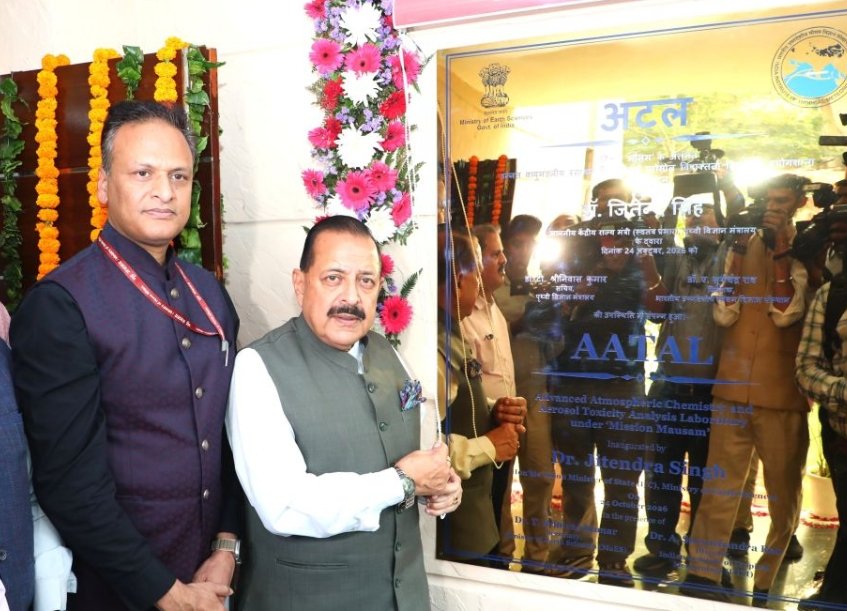
The inauguration of the Integrated Atmospheric Chemistry and Aerosol Toxicity Analysis Laboratory (AATAL) at the Indian Institute of Tropical Meteorology (IITM) represents an important development in this direction. The facility highlights the growing recognition that air pollution must be investigated beyond routine concentration measurements, incorporating chemical characterisation, source identification and toxicity assessment. This approach is particularly relevant for India, where the nature and behaviour of atmospheric pollutants differ considerably across geographical regions, climatic conditions and urban landscapes.
Understanding what particulate matter actually contains
Particulate matter is not a single pollutant but a complex mixture of particles originating from different natural and anthropogenic activities. PM10 and PM2.5 may contain mineral dust, crustal elements, trace metals, carbonaceous compounds and secondary inorganic constituents. Their composition depends on emission sources, atmospheric transformations and environmental conditions. Consequently, two locations recording comparable particulate matter concentrations may have substantially different chemical profiles.
This distinction is important because mass concentration alone cannot adequately describe the environmental and potential health significance of airborne particles. Chemical characterisation provides information about elemental composition and helps identify possible source signatures. Elements such as aluminium, iron, calcium and manganese may indicate contributions from crustal material and resuspended dust, whereas the presence and associations of certain trace metals can provide clues about traffic-related, industrial and combustion activities. However, individual elements are rarely exclusive to a single source. Their interpretation requires the combined assessment of chemical profiles, emission characteristics and statistical source-apportionment techniques.
Receptor models and multivariate statistical approaches can help distinguish the contributions of different sources to ambient particulate matter. Such investigations are particularly important in Indian cities, where vehicular emissions, industrial activities, construction, road-dust resuspension, waste burning and regional transport may operate simultaneously. A scientifically defensible source assessment must therefore move beyond assigning pollution to a presumed activity and establish the contribution of different sources using measurable evidence.
The missing dimension: Understanding pollution across atmospheric heights
Another important consideration in urban air-quality assessment is the vertical distribution of pollutants. Most conventional monitoring networks are designed to measure ambient air quality at selected ground-level locations. Although these measurements are indispensable for regulatory assessment, they provide only a limited representation of atmospheric conditions across the urban vertical environment.
Urban buildings, particularly in rapidly developing cities with increasing high-rise construction, create complex aerodynamic conditions. Building height, street geometry, surface characteristics and surrounding structures influence airflow, turbulence and pollutant dispersion. Pollutant concentrations near pedestrian level may not necessarily represent conditions at intermediate building levels or rooftop environments. Similarly, pollutants released from elevated sources may undergo different dispersion pathways before reaching the surface.
Vertical profiling, supported by suitable airborne platforms and ground-based measurements, can help investigate these variations. Measurements at different heights can provide insights into pollutant accumulation, atmospheric mixing and the influence of local emission sources. Such information is relevant not only for understanding atmospheric processes but also for evaluating exposure in high-density urban environments. It suggests that future air-quality monitoring frameworks should consider the vertical dimension alongside conventional spatial monitoring.
Coastal cities require a different atmospheric perspective
The complexity becomes more pronounced in coastal urban environments. Unlike inland cities, coastal locations experience interactions between land–sea temperature differences, sea–land breeze circulation, humidity, temperature variations and regional wind systems. These meteorological processes influence the transport, dilution and redistribution of pollutants.
In India's coastal cities, the interaction between marine and terrestrial atmospheric conditions deserves particular scientific attention. Sea-breeze circulation may transport air masses inland, while changes in wind direction and atmospheric stability can influence the movement and dispersion of locally emitted pollutants. High relative humidity may also alter aerosol properties, including particle growth and atmospheric chemical processes. Seasonal transitions can further modify these interactions.
Therefore, interpreting particulate matter concentrations without considering concurrent meteorological conditions may lead to incomplete conclusions. Simultaneous observations of particulate matter, gaseous pollutants, temperature, relative humidity and wind characteristics are essential for understanding the processes governing urban air quality. This is also why pollution assessments conducted during a single season or at a limited number of locations may not adequately represent the longer-term behaviour of the urban atmosphere.
From chemical composition to health significance
The next critical step is understanding the potential toxicity of airborne particles. The health implications of particulate matter are influenced not only by the amount inhaled but also by its chemical composition, particle characteristics, exposure duration and individual susceptibility. Certain metals and combustion-related constituents are of particular concern because of their potential to contribute to oxidative stress, inflammation and other biological responses.
Chemical analysis, coupled with appropriate toxicological investigations and exposure assessment, can help strengthen the evidence linking atmospheric composition with potential health risks. However, estimated health risks should be interpreted carefully. Chemical concentrations and exposure-based risk estimates are valuable screening tools, but they should not be presented as direct evidence of disease occurrence. Integrating environmental measurements with epidemiological and toxicological evidence is necessary to develop a more complete understanding of the relationship between air pollution and human health.
This is especially relevant for vulnerable population groups, including children, older adults and individuals with existing respiratory or cardiovascular conditions. Understanding where pollutants occur, how their concentrations change and which chemical constituents are present can support more meaningful assessments of population exposure.
Making scientific evidence useful for environmental policy
The scientific value of advanced atmospheric research ultimately depends on its translation into effective environmental management. India's air-quality programmes, including the National Clean Air Programme, have strengthened monitoring and city-level interventions. However, the next stage should focus increasingly on understanding the actual contribution of different pollution sources and evaluating the effectiveness of interventions through reliable scientific evidence.
Real-time monitoring can help identify pollution episodes, but this information becomes more useful when integrated with chemical characterisation, source-apportionment studies and meteorological forecasting. If dust-related emissions dominate a particular pollution episode, appropriate dust-management measures may be prioritised. If combustion or industrial sources contribute substantially, interventions should focus on emission controls and compliance. Where regional transport plays a significant role, coordinated action across administrative boundaries becomes necessary.
Facilities such as AATAL can contribute to this transition by strengthening the scientific infrastructure required for atmospheric chemical analysis and toxicity assessment. However, advanced analytical facilities must be supported by sustained monitoring, standardised sampling protocols, quality assurance, skilled scientific personnel and accessible environmental datasets. Equally important is the need for stronger collaboration between research institutions, regulatory agencies, public-health experts and policymakers. Scientific advancements must also be complemented by stringent enforcement of air-quality regulations, continuous compliance monitoring and the involvement of subject experts in policy formulation and implementation.
India's air-pollution challenge cannot be addressed through a single monitoring technology or an isolated intervention. It requires an integrated understanding of pollutant concentrations, chemical composition, atmospheric movement, vertical distribution, source contributions and health implications.
Additionally, Scientific advancements must be complemented by stringent enforcement of air-quality regulations, with clear accountability and continuous compliance monitoring across pollution sources. Equally important is the involvement of subject experts from atmospheric science, environmental chemistry, toxicology and public health in policy formulation and implementation to ensure that interventions are scientifically sound, targeted and effective.
The real measure of progress will be the extent to which this scientific understanding translates into targeted emission reductions, better public-health protection and cleaner air. Moving beyond measuring pollution to understanding its chemical composition, sources and behaviour in the atmosphere is not merely a scientific advancement; it is essential for evidence-based air-quality management in India.
Dr Suresh Kumar Kolli, Associate Professor, Environmental Science, Department of Life Sciences, School of Science, GITAM (Deemed to be University)