The Syllabus Gap
October 01, 2026 | Thursday | Reports/white papers | By Ankit Kankar | ankit.kankar@mmactiv.com
How many years India’s biotech curriculum trails its factories. Eight technologies, the delay on each, who is quietly paying for it, and why the cheapest fix available is also the most neglected.
In October 2023, the Central Drugs Standard Control Organisation granted marketing authorisation to NexCAR19, India’s first indigenously developed CD19-targeted CAR-T cell therapy, produced by ImmunoACT, a company incubated at IIT Bombay under SINE. It was the culmination of roughly a decade of work between IIT Bombay and Tata Memorial Centre, built on a Phase I/II pivotal trial in 60 patients that reported around 70 per cent overall response rate. Within a year the therapy was reaching patients at more than 30 hospitals across more than 10 cities.
Here is the awkward part. A cell therapy facility needs process development scientists, cleanroom operators trained in aseptic technique, QC analysts who can run flow cytometry release assays, and QA staff who understand chain of identity and chain of custody for an autologous product where the batch size is one. India now needs those people in commercial quantity. Ask how many Indian universities teach autologous cell therapy manufacture as a manufacturing discipline, rather than as three slides inside a general immunology elective, and the honest answer is: very few, and most arrived after the approval rather than before it.
That interval, between a technology becoming commercially real in India and becoming teachable in an Indian classroom, is the subject of this analysis. It is not the same thing as the "skills gap" the sector has complained about for fifteen years, and the difference matters.
The gap is easy to miss because it does not look like failure. It looks like a well-run department with good placement figures, a laboratory full of working equipment, and graduates who pass their vivas. Nothing is broken. The syllabus was simply written for the industry that existed when it was approved, and it has been renewed rather than rewritten ever since. Ask a head of department when their bioprocess course was last restructured, as opposed to last revised, and the answer is frequently measured in decades.
A gap you can date
"Skills gap" is unfalsifiable. Every industry body claims one, every institution disputes its size, and nobody can settle the argument because there is no agreed unit of measurement. The phrase has generated a great deal of conference programming and no number anyone can check.
An interval is different, because both ends of it are documentable. Approvals are gazetted. Facility commissionings are disclosed. Course structures are published in institutional handbooks and recorded in Board of Studies minutes. Ask when a technology arrived commercially in India, then ask when it arrived in a syllabus, and you have a quantity rather than a grievance.
One caveat before the findings. A delay is not automatically a failure. Universities are not obliged to chase every commercial fashion, and the research-intensive institutions make a respectable case that fundamentals age better than platforms, and that a graduate who understands transport phenomena can learn any specific unit operation on the job. That argument has force. It also has a testable implication: an institution exercising genuine selectivity should be quick on some technologies and slow on others, reflecting deliberate choices. An institution that is uniformly slow across all eight is not exercising judgement. It is standing still.
THE INTERVAL
|
COMMERCIAL ARRIVAL
|
DELAY
|
CLASSROOM ARRIVAL
|
|
Regulatory approval, facility commissioning, or documented production run in India
|
measured
in months
→
|
A credit-bearing course: code, contact hours, assessment, transcript entry. Not a guest lecture, not a workshop.
|
Only credit-bearing courses count, and the technology must be the course’s principal subject rather than a single lecture inside a broader module. Where no such course exists, the delay is still running.
WHEN EACH TECHNOLOGY ARRIVED IN INDIA
|
Technology
|
Arrived
|
Marker event
|
Evidence
|
|
Biosimilar analytical characterisation
|
pre-2015
|
Sustained commercial biosimilars production
|
Sector-level
|
|
Data integrity / GxP computerised systems
|
2016 onward
|
Regulatory enforcement cycle on Indian sites
|
Sector-level
|
|
Single-use bioprocessing
|
2018–2019
|
Commercial-scale single-use trains commissioned
|
CONFIRM
|
|
Continuous manufacturing
|
2020–2022
|
Perfusion and continuous DSP in operation
|
CONFIRM
|
|
mRNA and LNP formulation
|
June 2022
|
DCGI EUA, GEMCOVAC-19 (Gennova)
|
Gazetted
|
|
Cell and gene therapy manufacturing
|
Oct 2023
|
CDSCO marketing authorisation, NexCAR19
|
Gazetted
|
|
AI-driven target discovery
|
Aug 2024
|
BioE3 Policy, Bio-AI hubs named
|
Cabinet
|
|
Synthetic biology and strain engineering
|
Aug 2024
|
BioE3 thematic sectors, biofoundries named
|
Cabinet
|
Two entries carry a flag. Single-use and continuous manufacturing have no single gazetted arrival date, and this analysis says so rather than smoothing it over; both rest on company-level commissioning disclosure. (Arrival dates in this Figure are drawn from regulatory notifications, Cabinet decisions and company disclosure)
What the gap looks like from a desk
Abstractions about curriculum reform are easy to nod along to. The distance becomes concrete the moment you set a hiring specification beside a transcript. Below is a composite drawn from cell therapy manufacturing roles advertised in India against the coursework a strong M.Tech or M.Sc. biotechnology graduate would typically carry into the interview.
THE SPECIFICATION AND THE TRANSCRIPT
|
What the role asks for
|
What the degree supplied
|
|
Aseptic technique in a Grade A/B environment
|
Sterile technique at an open bench, demonstrated once in a practical
|
|
Closed-system, automated manufacture
|
Manual operations on open glassware
|
|
Potency and identity assay development
|
Assay theory; running an established protocol
|
|
Batch release decision-making
|
Not encountered
|
|
Chain of identity and chain of custody
|
Not encountered
|
|
Deviation investigation and CAPA
|
Not encountered
|
|
Working to a validated electronic batch record
|
Laboratory notebook, unvalidated
|
|
Cryopreservation and cold chain logistics
|
Freezing cells for storage, no logistics context
|
Composite, illustrative of roles advertised in Indian cell therapy manufacturing. Three of the eight requirements are typically not encountered at all during a degree, and none of the three is intellectually difficult to teach.
The pattern in that table repeats across the other seven technologies with the nouns changed. The graduate is not undertrained in biology. They are untrained in the industrial context in which biology is practised, and that context is not an optional finishing layer. It is most of the job.
Eight technologies, eight delays
1. Cell and gene therapy manufacturing
Arrived: October 2023
What the job needs: Aseptic processing in Grade A/B environments, viral vector handling, closed-system automated manufacturing, potency and identity assay development, cryopreservation logistics, and documentation discipline for a batch of one.
Where the curriculum sits: Gene therapy appears in most Indian M.Tech and M.Sc. biotechnology syllabi, but as molecular biology. Standard PG syllabi place gene therapy systems alongside gene probes, DNA fingerprinting and siRNA silencing. That is science, not manufacture. The distance between "how a CAR construct works" and "how you release a CAR-T batch" is the entire commercial discipline, and it is largely unstaffed in Indian teaching departments because faculty who have run a GMP cell therapy suite are rare and command industry salaries.
How far behind: roughly three to four years where teaching now exists, and still running everywhere else.
2. mRNA and LNP formulation
Arrived: June 2022, when Gennova received DCGI Emergency Use Authorization for GEMCOVAC-19, India’s first indigenous mRNA vaccine and only the third mRNA COVID vaccine authorised anywhere. GEMCOVAC-OM, the Omicron-specific booster, followed on June 19, 2023, lyophilised and stable at 2 to 8 degrees Celsius, removing the ultra-cold chain constraint.
What the job needs: In-vitro transcription process control, capping and tailing chemistry, nucleoside modification, dsRNA impurity analytics, lipid nanoparticle formulation by microfluidic mixing, encapsulation efficiency measurement, lyophilisation cycle development.
Where the curriculum sits: The most instructive case of the eight, because the underlying science is within reach of any competent Indian biotech department. What is missing is formulation engineering. LNP work sits at the interface of chemical engineering and biology, and Indian biotechnology departments are overwhelmingly staffed from the biology side. Institutions with chemical engineering adjacency, in practice the older IITs, ICT Mumbai and several NITs, hold a structural advantage here that has nothing to do with intent or ambition.
How far behind: two to three and a half years, shortest where a chemical engineering department co-owns the teaching.
3. Single-use bioprocessing
Arrived: 2018–2019
What the job needs: Bag and tubing selection, extractables and leachables assessment, single-use sensor qualification, gamma irradiation validation, consumables supply chain qualification, waste stream management, and the economics of consumable-heavy manufacture.
Where the curriculum sits: This is the most damning of the eight. Downstream processing and bioreaction engineering are core in essentially every Indian M.Tech bioprocess programme, including at IIT Roorkee, IIT Delhi and IIT Guwahati. But the teaching hardware in most departments is stainless steel, sometimes a glass benchtop fermenter of a design predating the current cohort’s birth. A graduate who has only ever cleaned and sterilised a stainless vessel has been trained for a plant India is no longer building.
How far behind: five years and more, and mostly still running. The longest delay of the eight and the most tractable, because the barrier is capital, not pedagogy.
4. AI-driven target discovery
Arrived: August 2024 as policy, with commercial adoption running ahead of it. The Union Cabinet approved BioE3 on August 24, 2024, naming Bio-AI hubs and biofoundries as delivery infrastructure. Implementation has been concrete: the DBT-BIRAC joint call for Bio-AI hub proposals in April 2025 drew 284 letters of intent, of which 16 were shortlisted after four-stage evaluation, and a DBT-MeitY memorandum in August 2025 pairs MeitY compute and data infrastructure with DBT biological datasets.
What the job needs: Structure prediction and its failure modes, molecular property prediction, generative chemistry, ML operations on biological data, and, most underrated, the statistical literacy to recognise a model overfitting a small assay dataset.
Where the curriculum sits: Paradoxically the strongest position of the eight, because bioinformatics has been an Indian academic strength for two decades and computer science departments move quickly. The risk here inverts the others: courses that teach machine learning to biologists without ever putting them in front of real, dirty, small-n experimental data.
How far behind: one to two years, the shortest of the eight. Software carries no capital barrier.
5. Biosimilar analytical characterisation
Arrived: functionally before 2015, and that is the point. India has produced biosimilars for well over a decade. There is no recent marker event because the technology has been commercially live longer than most current undergraduates have been in school.
What the job needs: Multi-attribute method by LC-MS, glycan mapping, charge variant analysis, higher-order structure by HDX-MS and NMR, potency bioassay design, comparability statistics, and the regulatory logic of demonstrating similarity rather than equivalence.
Where the curriculum sits: A long-established commercial technology carrying a long-established teaching delay is the hardest finding here to explain away. Analytical characterisation is taught, but as instrumentation theory inside an analytical chemistry module. The specific intellectual skill of the biosimilars analytical scientist, constructing a statistically defensible similarity argument across dozens of quality attributes simultaneously, is close to absent from Indian syllabi.
How far behind: a decade or more at most institutions. If this analysis produces one headline number, this is the candidate.
6. Synthetic biology and strain engineering
Arrived: August 2024. BioE3 named high-value bio-based chemicals, biopolymers and enzymes, smart proteins and functional foods, and precision biotherapeutics among its thematic sectors, with biofoundries as delivery mechanism. Industrial enzyme and precision fermentation activity predates the policy; BioE3 is the defensible public marker.
What the job needs: Design-build-test-learn cycle management, genome-scale metabolic modelling, high-throughput screening and automation, strain stability assessment, and the scale-down and scale-up modelling connecting a 96-well plate to a 20,000-litre vessel.
Where the curriculum sits: Synthetic biology entered Indian syllabi relatively quickly, helped by iGEM participation and by being intellectually fashionable. The weakness is the "build" half. Foundry-scale automation needs liquid handlers and robotics few departments own, so students learn design and modelling and then meet a hardware wall.
How far behind: 18 months to three years on design; still running on automation and scale-up.
7. Continuous manufacturing
Arrived: 2020–2022.
What the job needs: Perfusion cell culture control, cell retention device operation, continuous chromatography including periodic counter-current and simulated moving bed, in-line buffer dilution, real-time release logic, and process analytical technology as a control philosophy rather than a sensor catalogue.
Where the curriculum sits: Almost universally taught in batch. Mass balance, unit operations, chromatography theory, all batch. Continuous processing is not a different machine, it is a different control paradigm requiring dynamic rather than steady-state thinking, and teaching it demands either hardware or a competent digital twin. Most departments have neither.
How far behind: four to six years, and mostly still running.
8. Data integrity and GxP computerised systems
Arrived: 2016 onward, driven by regulatory enforcement rather than technology adoption. Data integrity findings have been a recurring theme in observations issued to Indian manufacturing sites, and remediation has been among the sector’s largest sustained cost lines.
What the job needs: ALCOA+ principles, audit trail review, computer system validation, 21 CFR Part 11 and Annex 11 compliance, electronic batch record design, access control and segregation of duties, and the investigative discipline of a deviation.
Where the curriculum sits: The most under-appreciated finding of the eight. It is the technology with the clearest quantified commercial consequence for Indian industry, and the one least likely to appear anywhere in an Indian biotechnology degree. It is taught, when at all, in fortnight-long industry inductions to graduates who have never met the concept. It is also the cheapest of the eight to teach well: no capital equipment, no bioreactor, just a validated electronic system, a set of redacted real-world findings, and a faculty member who has survived an inspection.
How far behind: the better part of a decade, and still running almost everywhere.
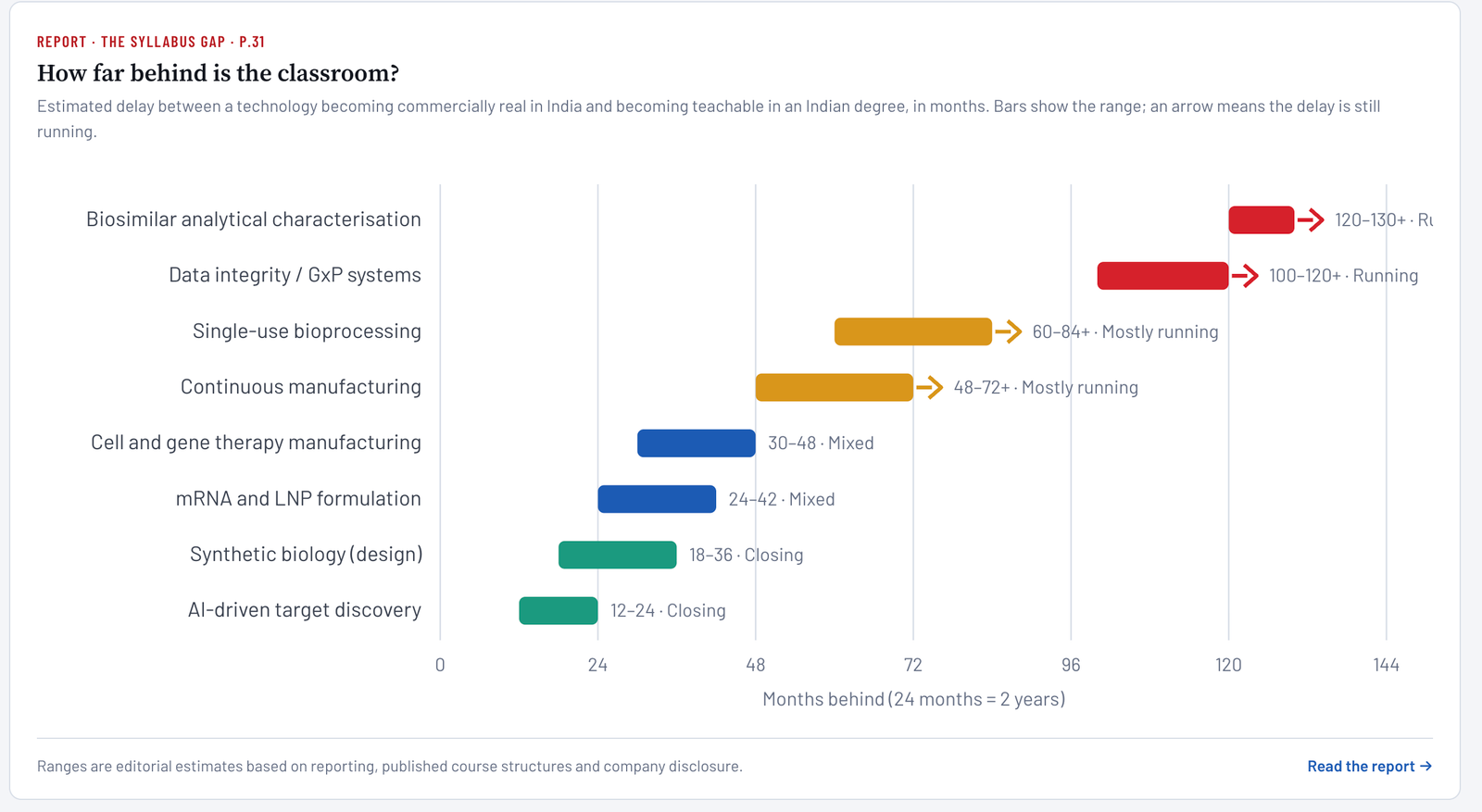
HOW FAR BEHIND, BY TECHNOLOGY
Chart type: horizontal floating-bar chart. Technologies on Y axis ordered longest to shortest, months on X axis, 0 to 130. Still-running delays rendered in oxblood with an arrow terminal. The block column indicates relative bar length for layout only.
|
Technology
|
Lower
|
Upper
|
Status
|
Relative delay
|
|
Biosimilar analytical characterisation
|
120
|
130+
|
Running
|
█████████████
|
|
Data integrity / GxP systems
|
100
|
120+
|
Running
|
████████████
|
|
Single-use bioprocessing
|
60
|
84
|
Mostly running
|
████████
|
|
Continuous manufacturing
|
48
|
72
|
Mostly running
|
███████
|
|
Cell and gene therapy manufacturing
|
30
|
48
|
Mixed
|
█████
|
|
mRNA and LNP formulation
|
24
|
42
|
Mixed
|
████
|
|
Synthetic biology (design)
|
18
|
36
|
Closing
|
████
|
|
AI-driven target discovery
|
12
|
24
|
Closing
|
██
|
Ranges are editorial estimates based on reporting and must be labelled as such in the published chart. The ordering, not the precision, is the finding. (Delay ranges in this Figure are editorial estimates based on published course structures and are presented as ranges for that reason)
Four reasons, not one
Read across the eight and four distinct causes emerge. They matter more than any individual number, because they determine which delays close with money, which need people, and which need only a decision.
Capital. The shortest delays cluster where teaching needs only software and a laptop. The longest cluster where teaching needs a bioreactor, a cleanroom, a liquid handler or a validated computerised system. Institutions are not refusing to teach single-use bioprocessing on principle. They cannot fund the consumables, and consumables are an operating cost rather than a one-time grant line, which is precisely the expenditure category Indian institutional budgeting handles worst. A department can win a grant for a bioreactor and then be unable to buy bags for it.
Faculty. Cell therapy manufacture, continuous processing and data integrity all require an instructor who has done the thing in a regulated environment. That person currently earns several multiples of an assistant professor’s salary. Until Professor of Practice appointments move from ceremonial to structural, and are paid accordingly, these delays persist regardless of how many memoranda get signed.
Governance. A new credit-bearing course passes through a Board of Studies, an academic council and sometimes a statutory body. Even a motivated department needs two to four semesters to get a course coded and offered. That is one to two years of delay accrued before anyone has been slow, and any fair reading should subtract it before assigning blame. Private universities with unitary governance can move faster; whether they actually do is worth asking them directly.
Adjacency. mRNA formulation lands well where chemical engineering sits next door. AI-driven discovery lands well where computer science does. Biotechnology departments that are institutionally isolated run longer delays across the board, irrespective of the quality of their biology.
WHICH DELAYS CLOSE WITH MONEY, AND WHICH DO NOT
| |
LOW CAPITAL
|
HIGH CAPITAL
|
|
FACULTY
SCARCE
|
A PEOPLE PROBLEM
Data integrity / GxP systems
|
MONEY AND PEOPLE
Cell and gene therapy manufacturing
Continuous manufacturing
mRNA and LNP formulation
|
|
FACULTY
AVAILABLE
|
A DECISION PROBLEM
AI-driven target discovery
Synthetic biology (design)
|
A MONEY PROBLEM
Single-use bioprocessing
Biosimilar analytical characterisation
|
The lower-left quadrant is the sector’s cheapest available win. Data integrity sits immediately above it, held back by faculty scarcity rather than cost, and that scarcity is solvable by secondment rather than recruitment.
Somebody is already paying for this
The delay does not sit in a ledger anywhere, which is why it goes unmanaged. But it is being paid for, by three parties, none of whom see the full bill.
Employers pay it as onboarding. Every large Indian manufacturer runs an induction programme that is, in substance, remedial teaching. Aseptic behaviour, documentation discipline, deviation handling, the working logic of a quality system: all delivered in weeks, to graduates encountering the concepts for the first time, by staff whose actual job is production. The cost is real and it is recurring, but because it is booked as training rather than as a curriculum failure, nobody aggregates it. Any editor reporting this story should ask three manufacturers a single question: how many weeks before a new science graduate is independently productive, and what was that number ten years ago.
Graduates pay it in starting position. A candidate who cannot demonstrate regulated-environment competence enters at the trainee rung regardless of the quality of their degree, and the first two years are spent acquiring what a better-designed course would have supplied in a semester. The opportunity cost compounds, and it falls hardest on students from institutions without industry proximity, which is to say most of them.
The exchequer pays it twice. Once to fund the degree, and again to fund the skilling scheme that exists because the degree did not deliver. India has built a substantial parallel apparatus of finishing schools, skill missions and industry certificates, much of which teaches material that could have been credit-bearing coursework at a fraction of the marginal cost. That parallel system is not a scandal; it is a rational response to a real shortfall. But it is a workaround, and workarounds that persist for a decade stop being temporary.
What comparable economies did
Two small, export-oriented economies faced a recognisably similar problem and solved it the same way, which is worth noting because neither solution required reforming the university system.
Ireland, building a biologics manufacturing base largely on inward investment, established a dedicated national training institute in Dublin built around a replica commercial-scale production facility, jointly supported by state development agency funding and industry. Students, and working professionals, train on equipment configured the way a real plant is configured. The university degrees did not have to change; a shared facility was interposed between them and the factory floor.
Singapore took a comparable route through its national research agency, coupling process development institutes to a deliberate biologics manufacturing build-out, with training treated as infrastructure to be funded rather than an outcome to be hoped for.
The transferable lesson is not the specific institutional form. It is the recognition that the expensive tier of training is a shared good. No single department can justify a cleanroom for teaching, so no single department builds one, and the shortfall persists indefinitely at every campus simultaneously. India already has the raw material for the same solution in its BIRAC-funded incubator and bio-cluster infrastructure. What is missing is a mandate for structured student access.
What it would cost to close
The most useful thing an analysis of this kind can do is convert a complaint into a budget line. Rough orders of magnitude, drawn from what departments already spend on comparable teaching infrastructure, offered as a starting point for negotiation rather than a quotation:
THREE TIERS OF INTERVENTION
|
Tier
|
Order of cost
|
Technologies
|
Binding constraint
|
|
ONE
|
Under aRs 10 lakh per course, per year
|
Data integrity and GxP systems; AI-driven target discovery; synthetic biology design
|
A person, not a purchase order. Validated software environment, cloud credits, curated datasets, instructor time.
|
|
TWO
|
Rs 50 lakh to Rs 2 crore capital, plus recurring consumables
|
Single-use bioprocessing at teaching scale
|
An annual consumables line most departments have never had to budget for. Highest-return single intervention available.
|
|
THREE
|
Rs 5 crore and upward
|
Cell and gene therapy manufacture; continuous processing at meaningful scale
|
Cleanroom construction and qualification. Shared-facility territory: regional teaching hubs on existing BIRAC infrastructure, not replication per campus.
|
The tiering carries a strategic implication, and it is the sharpest thing in this analysis. If an institution is slowest precisely where the cost is lowest, as most Indian universities are on data integrity, then cost is not the explanation. Attention is.
Three objections
That the material is already "covered within" an existing course. This is the response any reporter will hear first, and it is testable. Ask for the course code, the lecture schedule, the contact hours devoted to the topic, and the assessment weighting. Where a department produces them, the point is conceded and the teaching is real. Where it cannot, the coverage is aspirational. This is not an adversarial standard; it is the one any accreditation body applies, and departments genuinely teaching the material clear it without difficulty.
That chasing industry produces graduates trained for obsolete platforms. This deserves more sympathy. Every technology on the list has a half-life. Single-use displaced stainless; something will displace single-use. The counter is that all eight have a documented Indian commercial base rather than a speculative one, and that the underlying transferable skill, aseptic thinking, control philosophy, comparability logic, survives the platform that taught it. A student who has run a single-use train understands contamination control in a way no lecture delivers, and that understanding transfers.
That universities are not vocational schools. True, and the argument cuts both ways. Nothing here suggests an IIT should teach batch record completion instead of thermodynamics. But data integrity is not a clerical skill, it is an epistemology of evidence, and comparability assessment is applied statistics. The eight technologies on this list are not trade skills dressed up. They are where the intellectual frontier of the discipline currently sits, which is precisely why their absence from syllabi is difficult to justify on academic grounds.
What would actually move
Three things, in ascending order of difficulty.
Teach data integrity next year. It requires no capital equipment, and the teaching material, redacted regulatory findings, is public. The only missing input is an instructor who has been inspected, and industry has thousands of them. A one-semester secondment arrangement between a single large manufacturer and a single department would demonstrate the model, and the cost to the manufacturer is one person’s time for four months.
Fund consumables, not just equipment. The single-use delay is the longest of the eight and the most easily addressed, and it persists because grant structures reward capital purchases and ignore the recurring spend that makes equipment usable. A funding line for teaching consumables, at a fraction of the cost of the hardware already sitting in Indian departments, would close more distance per rupee than any other intervention available.
Share the expensive facilities. Cell therapy and continuous processing at meaningful scale are beyond individual departmental budgets and will remain so. The realistic model is a small number of regional teaching facilities attached to existing BIRAC-funded infrastructure, with structured access for students from multiple institutions, on the correct assumption that no single university can justify the capital alone.
None of this requires a new policy. BioE3 already names the outcomes; what it does not yet carry is a workforce annexe stating how many people, in which roles, by when. That number does not appear to exist, and its absence is the most consequential finding here. A biomanufacturing strategy without a headcount plan is a capital plan, and capital plans in this sector have a way of arriving on schedule and then standing idle for want of the people to run them.
The eight delays in this analysis are not evidence that Indian biotechnology education is poor. Several of these departments do research that would be competitive anywhere. They are evidence of something more mundane and more fixable: that the machinery for updating what is taught runs slower than the machinery for changing what is made, and that nobody owns the difference. Until someone does, the shortfall will keep being described as a skills shortage, which is a way of naming the problem without dating it.
Ankit Kankar
ankit.kankar@mmactiv.com
-----------------------