Bengaluru Innovation Report 2026 highlights opportunities for biotech, life sciences and healthcare innovation
November 19, 2026 | Thursday | News
Karnataka’s expanding deep-tech and artificial intelligence ecosystem, backed by growing startup funding, government support and research infrastructure, offers new opportunities for biotechnology, healthcare technology and life sciences innovation beyond Bengaluru
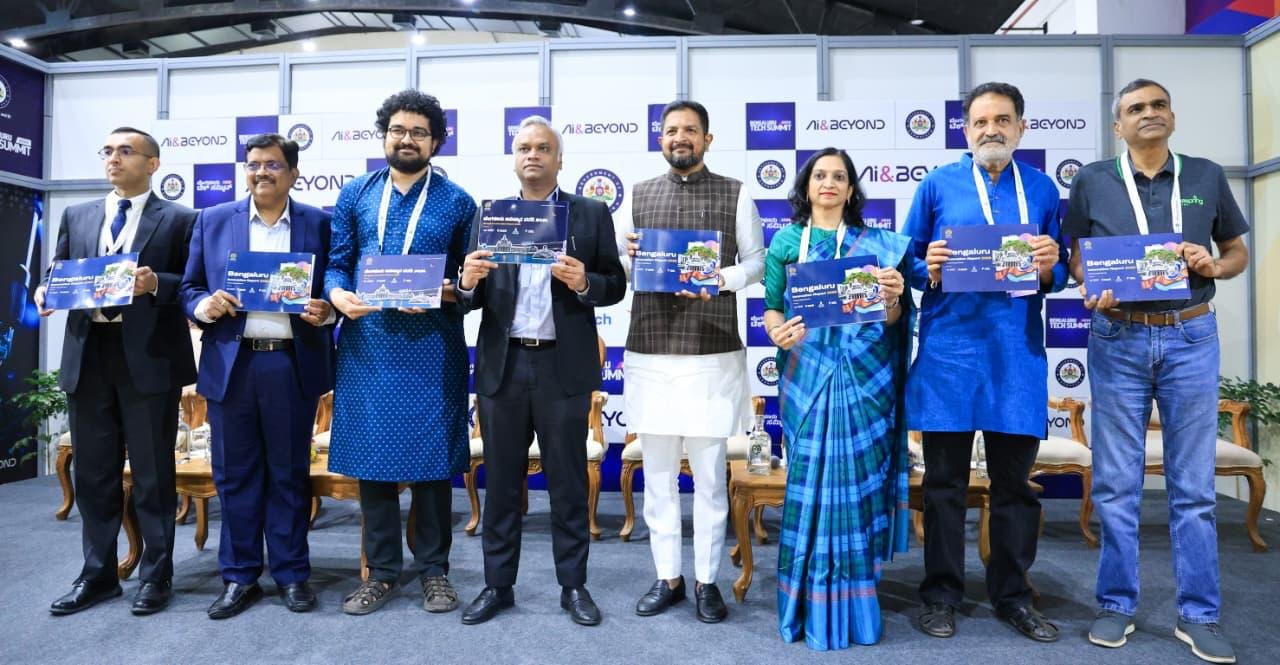
Priyank M. Kharge, Minister for Home, Electronics, Information Technology, Biotechnology and E-Governance, Government of Karnataka, released the Bengaluru Innovation Report 2026 at the Bengaluru Tech Summit on November 18, 2026, highlighting the city’s growing position as a national hub for artificial intelligence (AI), deep technology and innovation.
Prepared by the Karnataka Digital Economy Mission (KDEM) in collaboration with 3one4 Capital, with data from Tracxn, the report examines Bengaluru’s startup ecosystem, funding landscape, emerging technologies, unicorns and the development of innovation clusters beyond the state capital.
While the report highlights Bengaluru’s leadership in AI and deep technology, its findings also point to opportunities for biotechnology, life sciences and healthcare innovation, particularly as AI, advanced computing and other emerging technologies increasingly intersect with drug discovery, diagnostics, precision medicine and healthcare delivery.
Bengaluru strengthens its deep-tech leadership
According to the report, Bengaluru is home to 1,556 deep-tech startups founded since 2010, of which 1,319 remain active and funded. Collectively, these companies have raised $3.77 billion. The city also has 799 native AI startups, of which 764 are active and funded.
Bengaluru accounts for 36.3 per cent of India's native AI startup funding, the highest share among Indian cities, and is home to 71 per cent of the country's AI and deep-tech unicorns created since 2023.
The scale of this ecosystem is significant for life sciences, where AI and deep-tech capabilities are increasingly being applied to computational biology, drug discovery, molecular diagnostics, clinical research, medical devices and healthcare automation. The availability of technology talent, venture capital and research capabilities could support the development of companies working at the intersection of biology, engineering and digital health.
Capital availability supports innovation-led enterprises
Bengaluru-based startups have raised approximately $85 billion since 2010, accounting for 47 per cent of the total venture funding raised by Indian startups. Of this, $76.5 billion was raised over the past decade.
The city has 3,810 active, funded startups founded since 2010, nearly twice Mumbai's 1,982. It is also home to 212 soonicorns, representing 36 per cent of India's total, indicating a substantial pipeline of companies progressing towards unicorn status.
The report identifies approximately 300 venture capital firms operating in Karnataka, while Bengaluru has 75 Category I Alternative Investment Funds (AIFs), accounting for 21 per cent of India's total.
For emerging life sciences ventures, access to patient capital remains particularly important given the longer development cycles, regulatory requirements, infrastructure investments and clinical validation involved in biotechnology and healthcare innovation.
The report also points to growing domestic participation in the investment ecosystem, with 52 per cent of capital raised by Category I and II AIFs now coming from domestic investors.
Government support and Beyond Bengaluru expansion
The State Government's ELEVATE grant-in-aid programme has supported 1,479 startups with Rs 393.58 crore since 2017, with 38.6 per cent of beneficiaries located beyond Bengaluru.
The State has also established a Rs 75 crore Beyond Bengaluru Cluster Seed Fund as a SEBI-registered Category I AIF. Global Technology Centres are being developed in Mysuru, Hubballi and Belagavi, while the Rs 1,000 crore Local Economy Accelerator Programme (LEAP) aims to generate five lakh jobs over five years.
These initiatives could help expand the geographical footprint of Karnataka's innovation ecosystem, including opportunities for biotechnology, agribiotechnology, healthcare technology and research-driven enterprises to emerge from regional clusters.
Releasing the report, Priyank Kharge said Karnataka's next priority was to ensure that companies working in areas such as AI, quantum technology and semiconductors could grow beyond Bengaluru, including in Kalaburagi, Hubballi and Mangaluru. "Deep tech rewards patience, and Karnataka will stay the course," he said.
Dr Manjula N, Secretary, Department of Electronics, IT, BT and S&T, Government of Karnataka, highlighted the role of government-backed programmes in translating early-stage innovation into commercially viable enterprises. She emphasised the importance of government as a first customer, patient capital for deep tech and moving research from laboratories into the marketplace.
BV Naidu, Chairman, KDEM, said the report provides investors, global capability centres and founders with a data-backed view of Karnataka's innovation ecosystem, from Bengaluru to emerging regional clusters.
A broader opportunity for Karnataka's life sciences ecosystem
For Karnataka's biotechnology and life sciences sector, the report provides an important picture of the wider innovation infrastructure that can support the next generation of technology-led enterprises. The convergence of AI, deep technology, research capabilities and venture capital offers potential to strengthen innovation across biopharma, diagnostics, medical technology and healthcare.
The challenge will be to translate this broader technology advantage into specialised life sciences capabilities, including stronger industry–academia partnerships, research commercialisation, technology transfer and access to long-term funding.