India performs world’s first dual-console complex robotic beating-heart TECAB surgery using indigenous technology
November 19, 2026 | Thursday | News
Landmark beating-heart TECAB procedure performed at Medanta Hospital using SSI Mantra system
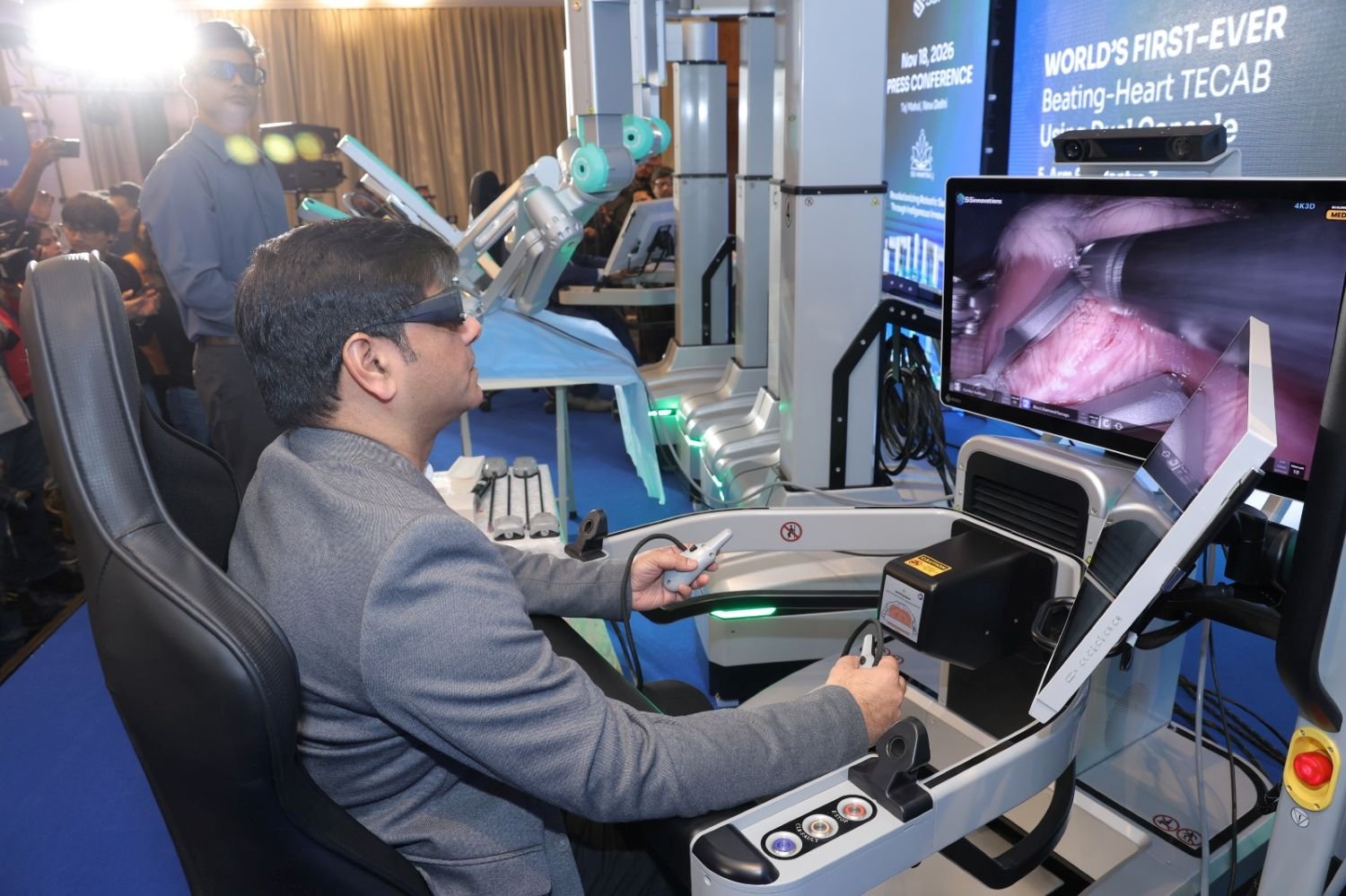
India has achieved a global milestone in robotic cardiac surgery with the successful completion of the world’s first dual-console, five-arm robotic beating-heart Totally Endoscopic Coronary Artery Bypass (TECAB) surgery using the SSI Mantra Surgical Robotic System at Medanta, Gurugram.
The procedure was performed by Dr Nitin Kumar Rajput, Associate Director of Robotic and Minimally Invasive Cardiac Surgery at Medanta, Gurugram and Dr Lalit Malik, Chief Cardiac Surgeon at Manipal Hospital, Jaipur under the supervision of Dr Sudhir Srivastava, widely considered as Father of Robotic Surgery In India, using two separate control consoles.
The surgeons operated in synchronisation to perform the complex procedure with all five robotic arms of the SSI Mantra system, deployed simultaneously in a dual-console configuration. A heart stabilisation system helped steady the target area while the heart continued to beat.
TECAB is a highly complex form of coronary artery bypass surgery performed through small incisions, without opening the chest, unlike a conventional sternotomy. In conventional procedures, one surgeon often needs to assist the other by operating the retractor or mobilising tissues to obtain a clear surgical view.
However, under this technique with a five-arm robotic configuration and dual-console control it enables more precise movements and better coordination. This level of precision can make a significant difference to the overall clinical outcomes, benefiting both the surgeon and the patient. The beating-heart approach allows surgeons to perform the bypass while the heart continues to beat, without using a heart-lung machine.
The procedure also brings attention to the potential recovery benefits of minimally invasive robotic cardiac surgery. In this case, the patient’s recovery progress over 15 days provides an important reference point for assessing the outcomes of the approach. The outcome represents an encouraging development in robotic cardiac surgery, where advances in surgical techniques and technology continue to expand treatment possibilities for patients.