Bio Connect 4.0: Kerala Makes Its Pitch From Lab Bench to Global Market
October 16, 2026 | Friday | News
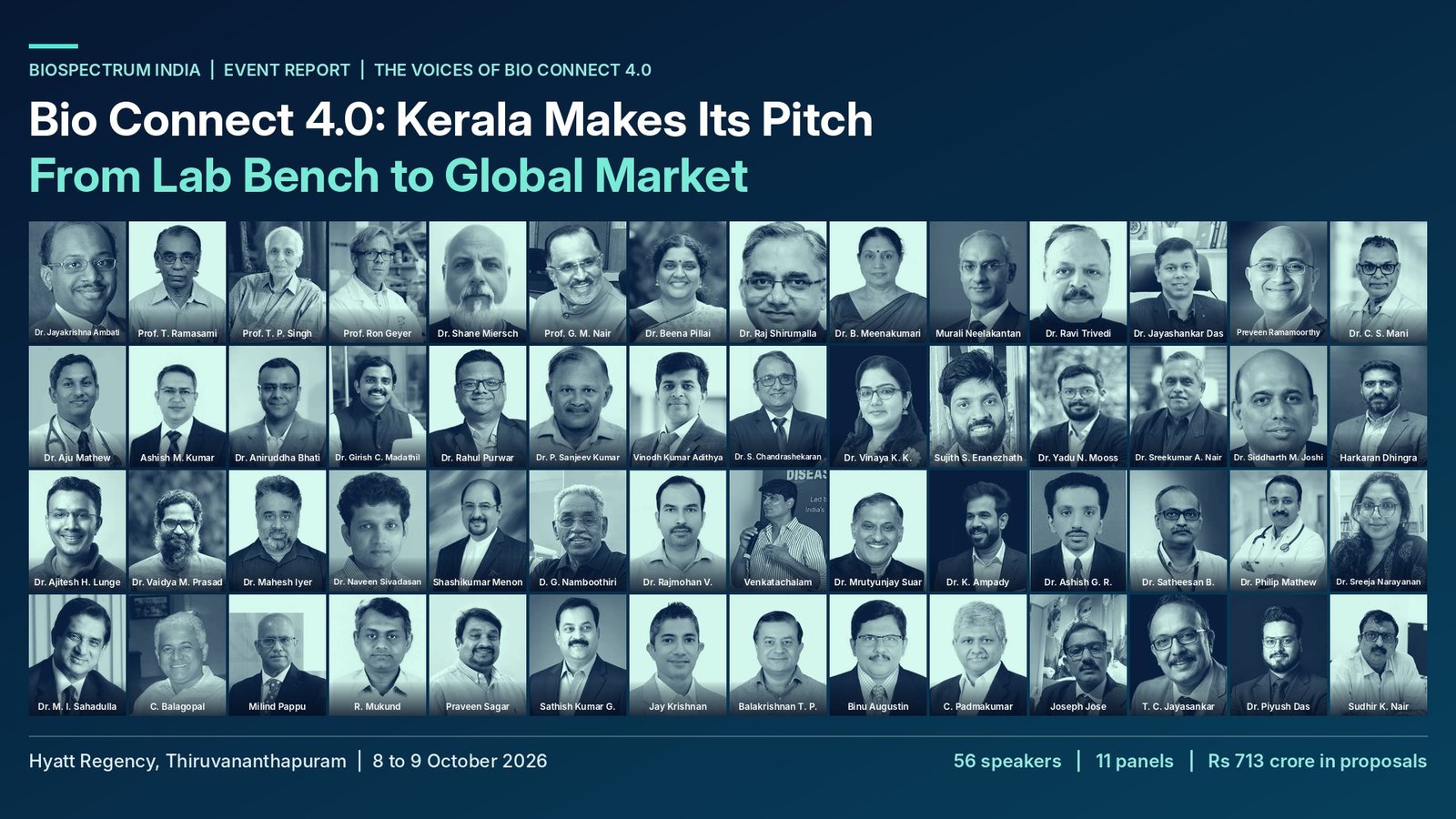
Two days, eleven panels, a parade of keynotes and Rs 713 crore in investment proposals. BioSpectrum India was at Thiruvananthapuram as Kerala Lifesciences Industries Parks set out to convert the state's scientific depth into enterprise, manufacturing and jobs.
If there was one idea that ran through every hall at Bio Connect 4.0, it was this: Kerala already has the science, the hospitals and the talent, and the next leap is about turning all of it into products, plants and payrolls. Over two packed days in Thiruvananthapuram, the fourth edition of the International Life Sciences Industries Expo and Conclave brought together global industry leaders, researchers, startups and policymakers to redefine the future of biotechnology, pharmaceuticals and medical research.
Organised by Bio 360 Life Sciences Park under Kerala Lifesciences Industries Parks Ltd (KLIP), a subsidiary of the Kerala State Industrial Development Corporation (KSIDC), the two-day conclave and expo was built to create meaningful connections between science, enterprise and public purpose. By the time the valedictory session wrapped up on Friday evening, the state had something tangible to show for it: three Memoranda of Understanding (MoUs) and four Expressions of Interest (EoIs) with a combined proposed investment value of Rs 713 crore.
BioSpectrum India attended both days. Here is how the conversation unfolded.
Day 1: Setting the Vision, Then Getting Down to Detail
A state-level opening
Day 1 opened with registration from 8 am, followed by the Inaugural Session and Exhibit Inauguration in the Grand Ball Room. Chief Minister V. D. Satheesan inaugurated the conclave and delivered the presidential address on the theme of Kerala's 'Next Development Leap'. His message to investors and innovators was one of government backing, with a focus on simplifying regulatory procedures and speeding up investment clearances. He pointed to the state's new 'Saral Kerala' mechanism, a framework for simplified and accelerated regulatory approvals, as evidence that the government intends to remove friction for the sector.
Five keynotes, one argument
After a mid-morning tea break, the stage moved to a run of keynotes that, taken together, read like a policy brief for a life sciences state. Padma Bhushan Prof. T. Ramasami, Former Secretary, Department of Science and Technology, Government of India, set the scientific and strategic context, making the case for an integrated ecosystem that harnesses Kerala's healthcare infrastructure, research institutions, skilled workforce and connectivity, and builds stronger pathways from discovery to commercialisation.
He was followed by three senior figures from the Government of Keralam: Shri. A. P. M. Mohammed Hanish IAS, Additional Chief Secretary, Industries and Commerce; Shri. Minhaj Alam IAS, Additional Chief Secretary, Agriculture and Commissioner, Agriculture Production; and Shri. Snehil Kumar Singh IAS, Managing Director of KSIDC and KLIP. Between them, the three addresses covered the industrial, agricultural and infrastructure levers the state is pulling to attract life sciences investment, a clear signal that this is a whole-of-government priority rather than a single department's project.
The international voice of the morning belonged to Dr. Jayakrishna Ambati, Founding Director of the Center for Advanced Vision Science (CAVS) at the University of Virginia School of Medicine and President and CEO of Inflammasomes. After the networking lunch, Dr. Shane Miersch, CSO of Canada's Simisco Biologics, took the stage for a short keynote that set up the afternoon's scientific sessions.
Panel 1: AI moves into the life sciences mainstream
The first panel, 'Transforming Life Sciences Through Digital Innovation', was moderated by Dr. Mahesh Iyer, Head, Data and Qualitative Sciences at Bristol Myers Squibb. The panel brought together the IT services view and the startup view in one conversation: Dr. Naveen Sivadasan, Principal Scientist at Tata Consultancy Services (TCS); Dr. Ajitesh Lunge, CEO and Co-Founder of Locksmith Bio; Dr. Siddharth Joshi, Director, Business Strategy at LTM; and Dr. Vinodh Kumar Adithya, CEO of Capla GmbH. The discussion centred on where data science and AI are already changing R&D practice, and what it will take for Indian companies to build and deploy these tools at scale.
Panel 2: From discovery to next-generation healthcare
The biopharma track followed, with Dr. C. S. Mani, Surgical Oncologist at Apollo Hospital, Chennai, moderating a panel that spanned industry, entrepreneurship, international biologics and academia. Dr. Ravi Trivedi, Vice President, Zydus Lifesciences; Dr. Preveen Ramamoorthy, CEO of T Therapeutics LLC; Dr. Shane Miersch of Simisco Biologics; and Prof. Rahul Purwar of IIT Bombay examined the journey from the laboratory to next-generation therapies, and where India can compete on innovation rather than cost alone.
Fireside chat: Beyond generics
One of the most anticipated sessions of the day was the fireside chat 'Beyond Generics: From Molecular Discovery to Global Innovation', bringing Dr. Jayakrishna Ambati into conversation with Dr. C. N. Ramchand, CEO and Founder of MagGenome Technologies, hosted by Ms. Vachas. The theme went to the heart of India's long-running debate: how a country that built its pharma reputation on generics can produce more original molecules that compete globally.
The MedTech afternoon: Rs 40,000 crore and a 2032 vision
The late afternoon belonged to medical technology, and this is where Kerala's ambitions were spelled out in numbers. Shri. C. Padmakumar, Special Officer of the Kerala Medical Technology Consortium (KMTC), presented 'The Rs. 40,000 Crore MedTech Opportunity for Keralam', then moderated Panel 3, 'Realising the Kerala MedTech Vision 2032'. His panel was a who's who of the state's device makers: Shri. Balakrishnan T. P. of i2R Labs; Shri. T. C. Jayasankar, General Secretary of KMDIA and MD of Jayon Implants; Shri. Joseph Jose of Mariya Healthcare; Shri. Binu Augustin, Treasurer of KMDIA and Director of Heka Medicals India; and Shri. Sudhir Nair of Agappe Diagnostics.
Panel 4 zoomed in on 'The Trivandrum Medical Device Cluster'. Moderated by Shri. C. Balagopal, Chairman of KSIDC and KLIP, it featured Dr. M. I. Sahadulla, CMD of KIMS Health; Shri. Mukund R. Pillai, Executive Director, Operations at HLL Lifecare; Shri. Sathish Kumar, Managing Director of Terumo BCT; and Shri. Praveen Sagar, CTO of Ox Devices. The mix of hospital, public sector manufacturer, multinational and young device company made the case that the capital city already holds the ingredients of a working cluster.
Shri. Milind Pappu, CEO of Nipro Medical India, delivered the evening keynote before Panel 5, 'Innovation, Investment and Commercialisation of Medical Technologies', moderated by Dr. B. Satheesan, Director of MCC. Dr. Piyush Das of Haier Biomedical, Dr. Philip Mathew of Believers Church Medical College Hospital, Shri. Jay Krishnan of Beyond Next Ventures and Dr. Sreeja Narayanan of CUSAT took on the hardest question in medtech: how to move a device from prototype to procurement, and who funds the stretch in between.
The day closed with a cultural programme and gala dinner featuring national and international musical instruments, giving delegates the evening to continue conversations started in the halls.
Day 2: From Biologics to Ayurveda, Nutraceuticals and Agrifood
If Day 1 was about vision and devices, Day 2 widened the lens to the full sweep of Kerala's bioeconomy. Shri. Jose Kurian Mundackal, GM of KSIDC and CEO of KLIP, opened proceedings, followed by a keynote from Dr. Beena Pillai, Director of the Rajiv Gandhi Centre for Biotechnology (RGCB), Thiruvananthapuram, a reminder that the state's research institutions are central to its industrial plans.
Panel 6: Next-gen biologics
Panel 6, 'Next-Gen Biologics: From Discovery to Market', covered trends in biologic drug development, manufacturing scale-up and regulatory pathways. Moderated by Dr. Aju Mathew, Oncologist at Kerala Cancer Care, Ernakulam, it brought an unusual but useful mix: Shri. Murali Neelakantan, Principal Lawyer at Amicus, on the regulatory and legal side; Dr. Girish Chundayil Madathil, Co-founder and CEO of Luxmatra Innovations; and Prof. Ron Geyer of the University of Saskatchewan, Canada.
Panel 7: Ayurveda as an investment story
Kerala's heritage took centre stage in 'From Kerala's Heritage to a Global Investment Opportunity', moderated by Dr. Vaidya Prasad of Sunethri Ayurvedashram and Research Centre. With voices from Government Ayurveda College, Sreedhareeyam Ayurvedic Eye Hospital, Vaidyaratnam and the Incubation Centre for Ayurveda Innovation and Entrepreneurship, the panel explored how traditional knowledge can be backed by research and packaged for global markets.
Panel 8: Nutraceuticals, the next wave
Prof. G. M. Nair, Director of the Kerala Academy of Sciences, moderated 'Nutraceuticals: Unlocking Kerala's Next Wave of Health and Wellness Business', with Dr. Jayashankar Das of Elmentoz Research, Dr. Sreeraj Gopi of Molecules Biolabs, Dr. Sreekumar of Wellness Solutions and Dr. Vinaya K. K. of WellGenome. The discussion connected the state's botanical wealth with the fast-growing demand for evidence-based wellness products.
Panel 9: Make in India, make it at scale
The 'Make in India: Transforming Innovation into Manufacturing, Markets and Economic Growth' panel, moderated by Dr. Raj Shirumalla, Senior Scientific Advisor to the Government of India, produced one of the conclave's clearest takeaways. Panellists Dr. Aniruddha Bhati of DSS Takara Biosciences, Dr. Chandrasekharan of Vipragen Biosciences, Shri. Harkaran Dhingra of NeoDX and Prof. T. P. Singh of AIIMS argued that Kerala must close the gap between scientific research and market-ready products, strengthen domestic manufacturing, and invest in biotechnology, medical devices and the blue economy if it is to realise its life sciences potential.
Panel 10: Building Kerala's bioeconomy
Dr. C. N. Ramchand returned to moderate 'Kerala's Bioeconomy: Building a Sustainable Future Through Innovation and Investment', with Shri. Bijoy Nair of Nord Metallics and Bharat Biome, Shri. Balasubramanya S. of ABLE, Dr. Rijesh Krishna of IPTIF, Shri. Ramjee Pallela of EY and Dr. Ampady of KRIBS and BioNest. The conversation carried forward the momentum of the Kerala BioEconomy Report 2025, prepared by ABLE for KLIP and released at last year's edition, which put the state's bioeconomy at about US$ 7.53 billion and projected it to reach US$ 11 to 12 billion by 2030.
Afternoon: Agrifood, health policy and product launches
After lunch, Prof. Ron Geyer delivered a keynote before Panel 11, 'Innovations for Food Security and Sustainability', moderated by Dr. Meenakumari, Former Deputy Director General (Fisheries), ICAR. Shri. S. K. Menon of Q Life Consumer Products (NeST Group), Shri. Venkatachalam of Certitude Farms, Shri. Harshvardhan Joshi of Khadkeshwara Farms and Food, and Shri. Raj Dash of Bharat Biome brought the farm-to-fork perspective into a largely health-focused programme.
Dr. Sharmila Mary Joseph IAS, Principal Secretary, Health and Family Welfare, Ayush, Food and Civil Supplies and Consumer Affairs, delivered the final keynote, linking the state's health priorities with its industrial agenda. A dedicated product launch session followed, before delegates gathered in the Grand Ball Room for the valedictory session.
The Numbers That Matter
The headline outcome was Rs 713 crore in proposed investments, captured through three MoUs and four EoIs exchanged during the conclave. Participating organisations included Bharat Biome Life Sciences and central public sector enterprises, among others.
That figure is worth reading against the event's own history. The first two editions, Bio Connect 1.0 in 2023 and 2.0 in 2024, together drew more than Rs 180 crore in investments and created around 1,000 jobs, while the third edition in 2025 convened over 700 delegates and 75 exhibitors. On that trajectory, the fourth edition marks a step change in the scale of commitments on the table.
BioSpectrum India Takeaway
Bio Connect 4.0 was, at its core, a pitch, and a confident one. Kerala showed up with its chief minister, its senior bureaucracy, its research institutes and its device makers all telling the same story: the state has the science, the clinical base and the talent, and is now fixing the approvals and infrastructure needed to turn them into industry.
The real test lies ahead. MoUs and EoIs are statements of intent, and the measure of success will be how many convert into operational facilities at Bio 360 Life Sciences Park and beyond, and how quickly the Saral Kerala mechanism delivers on its promise of faster clearances. The medtech community, with its Rs 40,000 crore opportunity and its 2032 vision, has given itself a clear target. BioSpectrum India will be tracking how close Kerala gets.