Telangana sets global ambition with Life Sciences Policy 2026–30 targeting $25 B investments
January 21, 2026 | Wednesday | News
Aims to develop Telangana into one of the top five global life sciences clusters by 2030
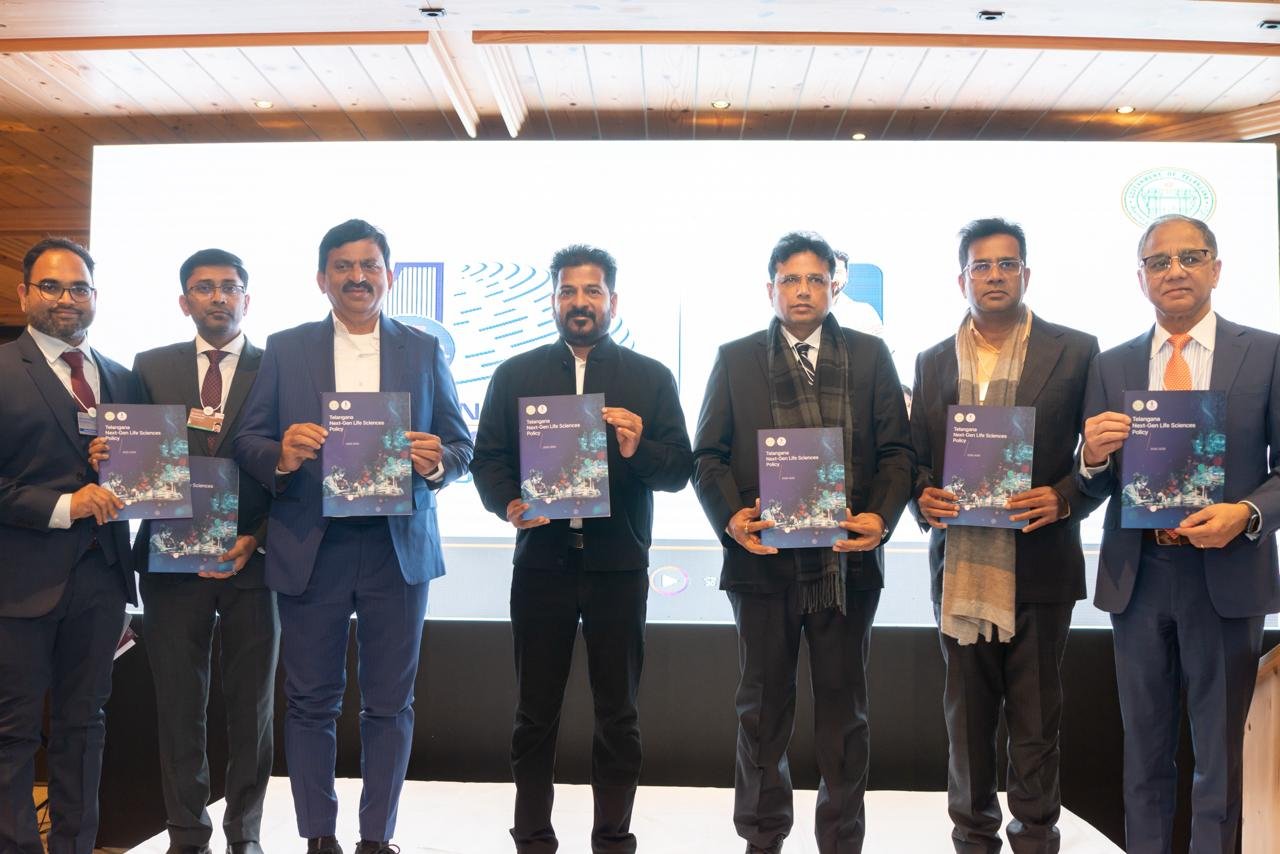
The Government of Telangana unveiled its Next-Gen Life Sciences Policy 2026–30 at the World Economic Forum Annual Meeting in Davos, signalling the State’s intent to play a far more consequential role in shaping the future of global healthcare, advanced therapeutics, and sustainable bio-manufacturing.
With a clear ambition to rank among the top five life sciences clusters worldwide by 2030, the policy targets $25 billion in investments, creation of 500,000 high-quality jobs, and deeper integration into global life sciences value chains.
The policy was unveiled by Chief Minister A. Revanth Reddy in the presence of the Minister for IT & Industries, D. Sridhar Babu; Special Chief Secretary Sanjay Kumar IAS, and the CEO, Telangana Lifesciences, Shakthi M. Nagappan.
The policy implementation will be anchored by globally benchmarked infrastructure, including the Green Pharma City, ten Pharma Villages, expansion of Genome Valley, and further strengthening of the Medical Devices Park.
Key Focus Areas of the Policy-
Frontier R&D and Advanced Manufacturing: Promotion of next-generation technologies and platforms, including biologics and biosimilars, cell and gene therapy, mRNA platforms, CRISPR technologies, antibody-drug conjugates (ADCs), oligonucleotides, peptides, and precision fermentation, with a focus on value-added and technology-intensive manufacturing.
Clinical Research: Strengthening the clinical trial ecosystem by enabling faster approvals, creation of disease-specific clinical registries, and operationalization of initiatives such as the Clinical Innovation Sandbox
Pharma Services: Expansion of the pharma services ecosystem, including Contract Research Organizations (CROs) and Contract Development and Manufacturing Organizations (CDMOs), to scale the sector from the current estimated size of USD 2 billion to approximately USD 10 billion.
Diagnostics and Medical Electronics: Development of a robust hub for research, development, and manufacturing of diagnostics and medical electronics.
Global Value Centres and Global Innovation Centres: Attracting Global Capability Centres (GCCs) and Global Innovation Centres focused on advanced analytics, artificial intelligence, engineering, digital health, and high-end R&D functions in the life sciences and healthcare domains.
Precision Medicine and Personalized Therapies: Advancing precision medicine through the development of clinical registries and privacy-compliant digital health records to enable personalized therapies, data-driven healthcare interventions, and improved clinical outcomes.
Strategic Levers for Implementation:
Infrastructure Development: The policy proposes the creation of world-class infrastructure to support the full life sciences value chain, including:
· Establishment of the Green Pharma City, a sustainable and integrated industrial cluster incorporating zero liquid discharge (ZLD), centralized waste management, energy-efficient systems, and net-zero practices.
· Development of ten (10) Pharma Villages, each spanning approximately 1,000 to 3,000 acres along the Outer Ring Road (ORR), to promote decentralized, balanced, and inclusive industrial growth across the State.
· Expansion of Genome Valley and establishment of a Bio-Innovation and Bio-Manufacturing Cluster in collaboration with Government of India, featuring multi-tenant laboratories and flatted factories to promote collaboration, innovation, and ease of entry for startups and MSMEs.
· The Policy also envisages the expansion of the Medical Devices Park, with enhanced common infrastructure and plug-and-play facilities to support R&D and manufacturing in medical devices and diagnostics.
Talent Ecosystem: The policy emphasises the cultivation of a dynamic and future-ready workforce through initiatives such as the flagship Telangana School of Life Sciences and other skilling and capacity-building platforms. Key measures include industry-aligned curricula, structured internships, lifelong learning pathways, and certification programs across critical domains such as biologics, advanced analytics, artificial intelligence and bioinformatics, and Health Outcomes and Economic Research (HOER).
Regulatory Streamlining and Ease of Doing Business: Implementation of TG-iPASS as a single-window system with time-bound approvals and deemed approvals in case of delays. The policy permits 24×7 operations in designated life sciences parks, subject to prescribed safety norms. A dedicated consultation committee (CDSCO, Telangana DCA, and TGPCB) to simplify state-level clearances and active advocacy with central regulators.
Funding Ecosystem: Establishment of a dedicated Life Sciences Innovation Fund with an initial corpus of Rs 100 crore ($12 million), scalable to Rs 1,000 crore ($111 million), structured through a public-private partnership model with co-investment alongside venture capital and private equity funds to support startups, scale-ups, and translational research initiatives.
Industry responds-
"Telangana has been setting the direction for the next phase of life sciences growth well ahead of the curve. Guided by the Hon’ble Chief Minister Shri Revanth Reddy's long-term vision and Shri D. Sridhar Babu, Hon’ble Minister for Industries, Commerce and IT passionate leadership, our Life Sciences Policy 2026–30 anticipated this shift by prioritising advanced and complex manufacturing, deep innovation and R&D, and the creation of a strong, globally integrated clinical research and clinical trial network. The Union Budget’s focus on precisely these areas now amplifies this momentum, accelerating our goal of attracting $25 billion in investments and generating 500,000 jobs while reinforcing Hyderabad’s position as a global life sciences innovation hub.”
Shakthi M. Nagappan, CEO, Telangana Life Sciences
“Telangana’s Next-Gen Life Sciences Policy 2025–30 is a timely and thoughtful step that reinforces the state’s ambition to be among the world’s leading life sciences hubs. By focusing on innovation-led growth, advanced manufacturing, and a strong science and talent ecosystem, the policy creates a compelling platform for companies like Sai Life Sciences to continue partnering with global innovators and advancing high-quality R&D from India for the world.”
Krishna Kanumuri, MD & CEO, Sai Life Sciences
“The life sciences sector in Telangana has emerged as a significant contributor to innovation, healthcare advancement, and economic growth, supported by a strong research base, growing industry presence, and a vibrant startup ecosystem. Building on this momentum, this Policy reflects a clear and timely vision to strengthen research capabilities, accelerate innovation, and translate scientific advances into meaningful health and economic outcomes. I am confident that the Telangana Next-Gen Life Sciences Policy will serve as a strong foundation for sustained growth and societal impact. I congratulate the Chief Minister and his entire team for taking this decisive step towards building a life sciences ecosystem that is resilient, inclusive and globally competitive."
Satish Reddy, Chairman, Dr. Reddy's Labs
“The NextGen Telangana Life Sciences Policy signals a bold transition from scale-led growth to an innovation-driven, value-centric model that the global life sciences industry increasingly needs. With its strong manufacturing base, regulatory credibility, and forward-looking investments in precision medicine, data-driven discovery, and sustainable infrastructure, Telangana is creating an ecosystem that can effectively translate science into scalable global impact. This policy has the potential to position the state among the world’s leading life sciences clusters and a credible global partner in shaping the future of healthcare.”
Kiran Mazumdar-Shaw, Executive Chairperson, Biocon Limited
“Telangana Next-Gen Life Sciences Policy 2026-30 is unique and transformative. It lays out a clear road map for being a dominant player in the emerging areas of healthcare, pivoting on innovation. This policy is a forward looking vision statement for the state which currently has a great life sciences ecosystem. Wishing all the success for this bold and ambitious vision.”
Dr Satyanarayana Chava, Executive Director and Chief Executive Officer, Laurus Labs
"Telangana's Next-Gen Life Sciences Policy 2026–2030 represents a transformative vision that positions the State at the forefront of global life sciences innovation. With Hyderabad as a global hub at the centre of Sanofi’s operations, this policy's ambitious framework for advanced biomanufacturing, talent ecosystems, and regulatory excellence creates unprecedented opportunities to redefine how we serve patients globally. I commend the Hon'ble Chief Minister and the Hon'ble Minister of Industries for their bold leadership in shaping the future of life sciences.”
Madeleine Roach, Executive Vice President, Business Operations, Sanofi
"At a moment when the global life sciences sector is undergoing profound transformation, Telangana’s Next-Generation Life Sciences Policy reflects a long-term vision that recognises the future of healthcare will be shaped not by isolated breakthroughs, but by strong ecosystems bringing together science, technology, talent, and policy coherence. By focusing on innovation, resilience, and global collaboration—and by anticipating the convergence of biology, data, and engineering—Telangana is positioning itself not just to participate in the future of life sciences, but to help shape it.”
Shyam Bishen, Head of Centre for Health & Healthcare, Member of Executive Committee, World Economic Forum
"Telangana’s life sciences policy demonstrates a timely commitment to MedTech-led innovation. This kind of forward-looking policy framework is critical to accelerating innovation and building globally competitive MedTech hubs. Our Medtronic Engineering & Innovation Centre (MEIC) in Hyderabad is a testament to Medtronic’s investment and partnership with the state of Telangana and is focused on accelerating innovation and putting patients first. I congratulate the Telangana government for their leadership and vision in shaping a policy that meaningfully advances innovation in healthcare."
Majid Kaddoumi, Executive Vice President, Eurasia