Nanotopography may hold key to tackling Alzheimer's, Brain Cancer: Prof. Prasad Shastri
August 07, 2026 | Friday | News
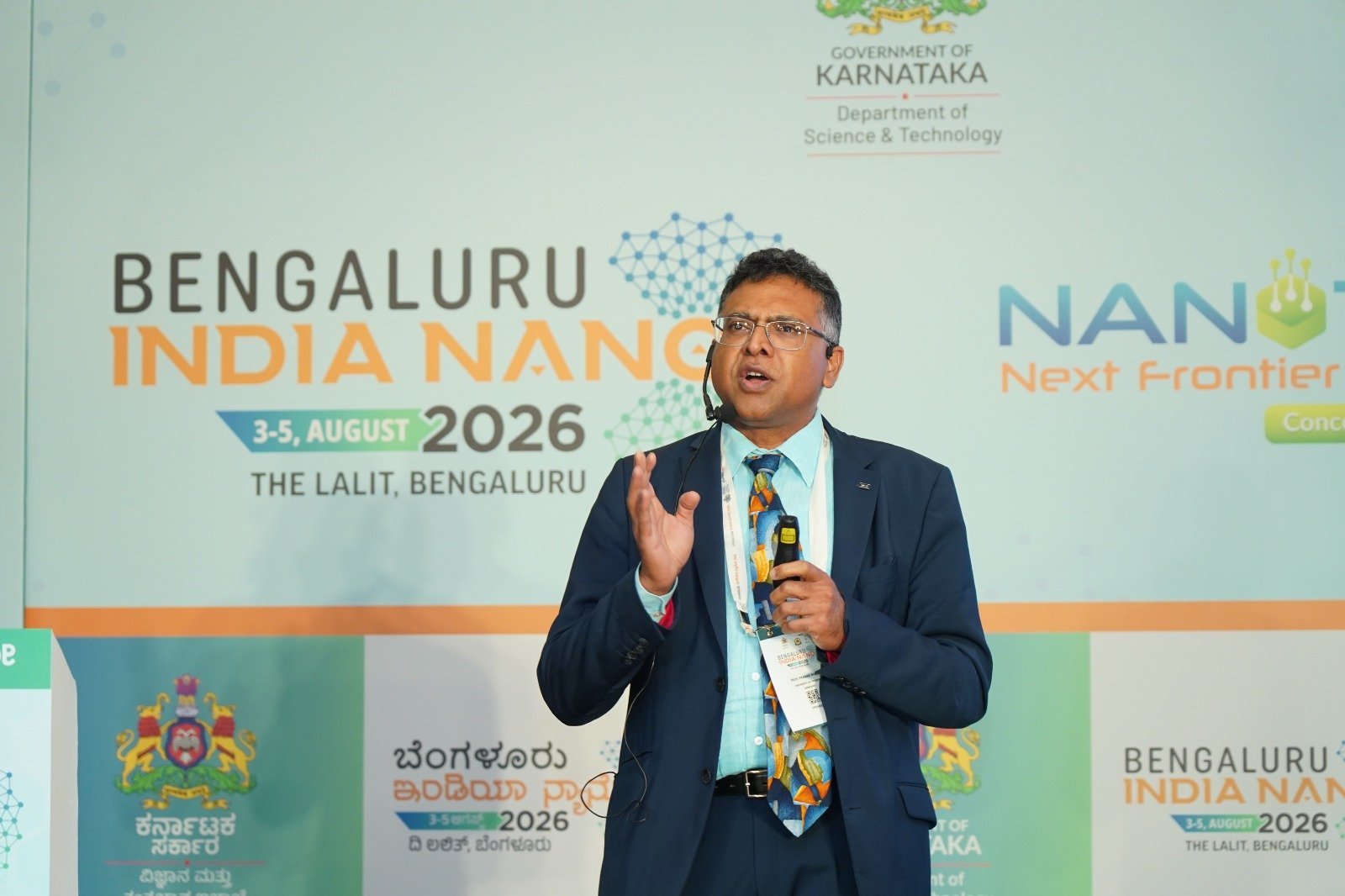
Prof. Shastri presented his latest findings at the Bengaluru INDIA NANO 2026 conference
A pioneering research programme led by Prof. Prasad Shastri of the University of Freiburg, Germany, has uncovered how nanoscale physical cues in the brain regulate neuronal behaviour, opening promising avenues for treating neurodegenerative diseases, improving brain implants and understanding the origins of brain cancer.
Presenting his latest findings at the Bengaluru INDIA NANO 2026 conference, Prof. Shastri challenged the long-held belief that biochemical signals alone govern brain function. Instead, his team demonstrated that the brain's nanoscale physical environment—or nanotopography—plays a critical role in controlling how neurons and supporting astrocyte cells communicate.
Over nearly two decades of research, the group developed engineered nanoparticle-based surfaces that mimic the brain's natural extracellular environment. Their studies showed that subtle changes in nanoscale surface roughness can alter cell shape, migration, differentiation and sensitivity to biological signals, revealing an entirely new layer of cellular regulation.
One of the team's most significant discoveries is the role of the mechanosensitive protein Piezo1 in neuronal health. The researchers found that neurons use Piezo1 to sense nanoscale mechanical cues in their surroundings. Analysis of human Alzheimer's brain samples revealed that regions surrounding amyloid plaques exhibit abnormal surface roughness that activates Piezo1-mediated mechanical signalling, potentially contributing to neuronal dysfunction and degeneration.
The findings suggest that mechanical changes in brain tissue, alongside biochemical abnormalities, could be an important driver of Alzheimer's disease progression.
The research also demonstrated that nanotopography can influence astrocyte behaviour. By engineering nanoscale coatings on neural electrodes, the team successfully prevented the formation of glial scars—a major challenge that limits the long-term performance of deep brain stimulation implants. Animal studies showed that coated electrodes significantly reduced astrocyte accumulation while maintaining normal device function.
Beyond neurodegeneration, Prof. Shastri's laboratory reported evidence that nanoscale mechanical environments may influence the earliest stages of glioblastoma development. The researchers observed that specific nanotopographical conditions induced astrocytes to form stable spheroid structures displaying gene expression patterns remarkably similar to the proneural subtype of human glioblastoma. Transcriptomic analysis identified more than 500 uniquely regulated genes, including alterations in key tumour-related pathways such as TP53 and NOTCH signalling.
According to Prof. Shastri, these findings indicate that physical cues within the brain microenvironment may contribute to tumour initiation alongside genetic mutations.
The research introduces a new mechanobiological framework for studying neurological disorders, suggesting that nanoscale physical properties of tissues could become therapeutic targets. Future applications may include next-generation neural implants, regenerative medicine strategies and novel interventions for Alzheimer's disease, Parkinson's disease and glioblastoma.
"Our work demonstrates that cells do not respond only to biochemical signals; they also interpret the physical landscape surrounding them. Understanding this mechanical language could fundamentally change how we approach neurological diseases," Prof. Shastri said during his presentation.
Narayan Kulkarni
narayan.kulkarni@mmactiv.com