Dextran in Freeze-Drying: Faster Processing and Improved Protein Stability
October 01, 2026 | Thursday | Features
Lyophilisation is widely used to improve the stability of proteins and other pharmaceutical products that are insufficiently stable in aqueous formulations.
Yet the process presents a familiar challenge for formulation and process development teams: how can drying time be reduced without compromising product quality and stability?
The choice of excipient can play an important role.
Sucrose and trehalose are widely used as cryo- and lyoprotectants in freeze-dried protein formulations. However, their relatively low glass transition temperatures can restrict the temperatures that can be applied during primary drying, contributing to longer drying cycles. Selected dextran molecular weights offer an interesting alternative because they provide higher glass transition temperatures than sucrose, which may allow higher primary-drying temperatures while maintaining protein activity under suitable formulation and process conditions.
Exploring Dextran 1 and Dextran 40
A study by Strøm Larsen et al. investigated dextrans of different molecular weights as cryo- and lyoprotectants, using lactate dehydrogenase (LDH) as a model protein. Nine dextran molecular weights were characterised for relevant glass transition properties, with Dextran 1 and Dextran 40 subsequently evaluated in freeze-drying experiments, both individually and in mixtures, and compared with sucrose.
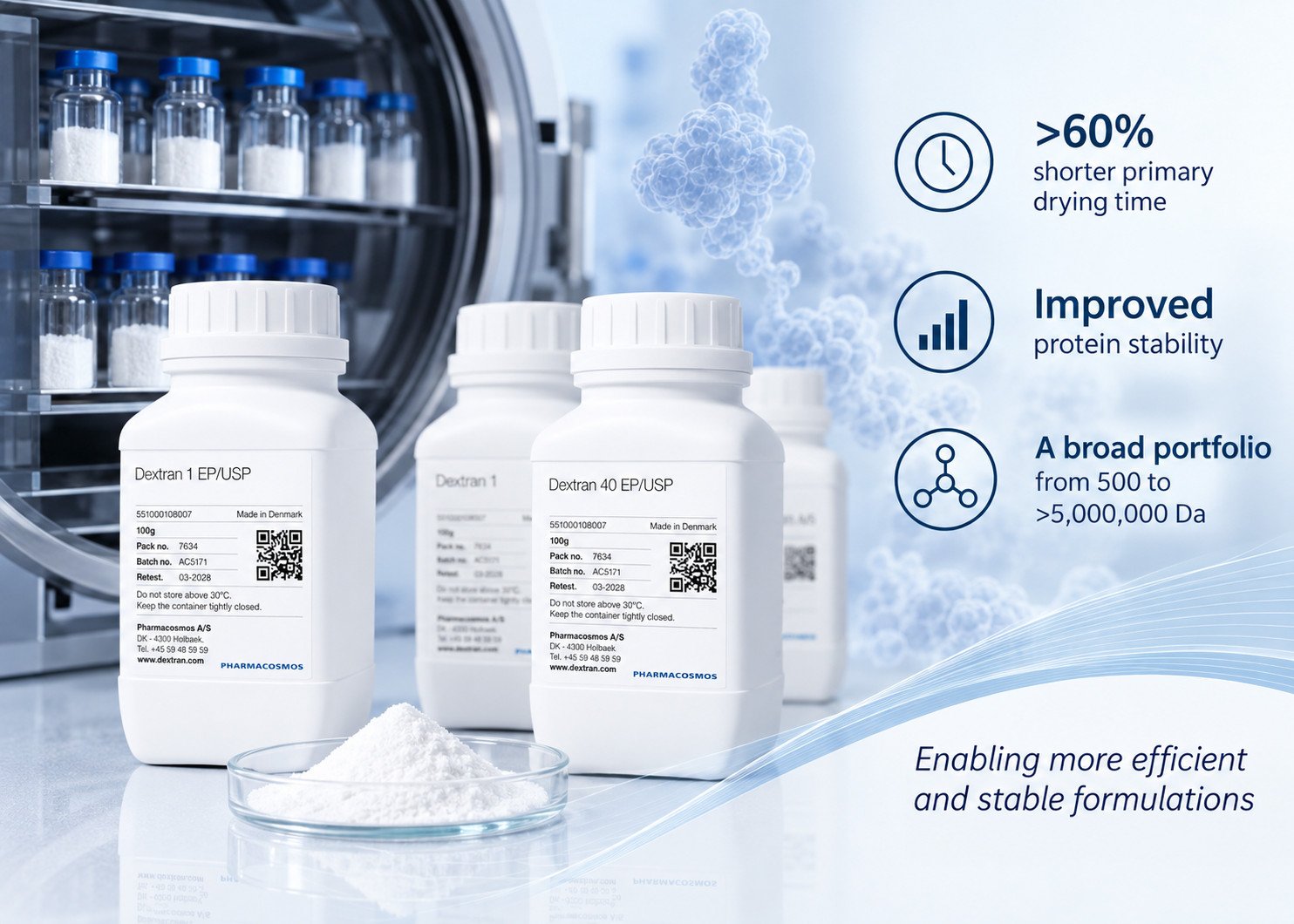
The results demonstrated a clear processing advantage under the conditions of the study. Primary drying was completed after approximately 5 hours for dextran-containing formulations compared with 16.5 hours for sucrose. The higher glass transition temperature of the maximally freeze-concentrated dextran solutions allowed a higher primary-drying temperature, resulting in a more than 60% reduction in primary drying time compared with sucrose in the applied freeze-drying cycle.
Importantly, faster processing did not come at the expense of LDH activity in the best-performing dextran formulation.
Among the formulations investigated, Dextran 40 provided the highest retained LDH activity following freeze-drying and during accelerated storage. The Dextran 40 formulation retained approximately 97% activity immediately after freeze-drying and 94% after seven weeks at 40°C, compared with approximately 86% and 27%, respectively, for sucrose. Dextran 1 retained approximately 82% immediately after freeze-drying and 54% after seven weeks at 40°C.
These findings illustrate how dextran selection may help address two important formulation-development objectives in lyophilised protein systems: shortening primary drying while supporting protein stability. However, the results should be interpreted as protein- and process-specific rather than as a universal ranking of excipient performance.
Molecular Weight Matters
The study also demonstrated that the physicochemical properties of dextran vary with molecular weight. Glass transition temperatures generally increased with increasing molecular weight, with the effect most pronounced at lower molecular weights and reaching a plateau around 40 kDa.
This was reflected in the LDH activity results. While both Dextran 1 and Dextran 40 enabled faster primary drying compared with sucrose, Dextran 40 provided the strongest protection of LDH during the applied freeze-drying process and under elevated storage conditions. The study also found no additional benefit from combining Dextran 1 and Dextran 40 compared with using pure Dextran 40.
The findings highlight an important consideration for formulation scientists: dextran is not simply one excipient. Its molecular weight can be a formulation parameter in its own right.
A Broad Dextran Toolbox from Pharmacosmos
Pharmacosmos offers a broad dextran portfolio spanning molecular weights from approximately 500 to over 5,000,000 Da, including pharmaceutical and technical grades, standards, derivatives and customised solutions.
Manufactured in a dedicated cGMP facility using a water-based process without organic solvents, our dextrans support major pharmacopoeial requirements including Ph. Eur., USP and JP. We combine carbohydrate expertise, pharmaceutical quality and manufacturing flexibility from development through scale-up.
Explore our portfolio at dextran.com or contact dextran@pharmacosmos.com.