The Race Beyond Equipment- How Biosuppliers Are Embedding Themselves in India’s Innovation Ecosystem
October 01, 2026 | Thursday | Features | By Ayesha Siddiqui
The life-science laboratory is becoming more than a place where instruments are installed and experiments are conducted. Across India, biosuppliers are increasingly embedding themselves in the research ecosystem through Centres of Excellence, application development, skills training, startup support and translational research. What began as a relationship built around access to advanced equipment is evolving into a broader partnership around capability building and innovation. The shift reflects a changing reality: sophisticated instruments alone do not create research advantage. Their value increasingly depends on the scientists who operate them, the applications they enable, the workflows they develop and the startups or industries that ultimately use the resulting capabilities. For biosuppliers, this is opening a new competitive frontier—one that extends beyond product specifications and procurement cycles. For academia, it raises an equally important question: can these partnerships create durable institutional capabilities rather than simply add another instrument to the laboratory? The answer may define the next phase of India's life-science innovation ecosystem.
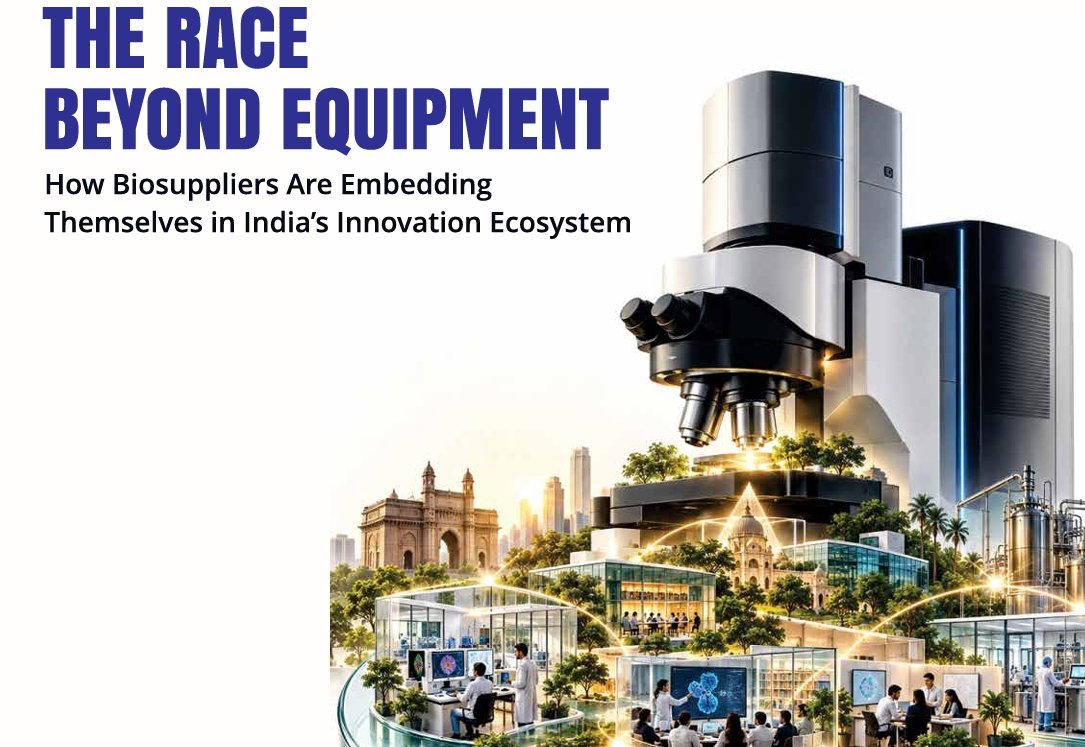
Image credit- shutterstock
Back in 2013, Waters Corporation selected St. John’s Research Institute (SJRI), Bengaluru, for its Centers of Innovation Programme to advance research in structural proteomics. SJRI became the first institution in India to receive the designation of a Waters Center of Innovation, marking an early example of a biosupplier and an Indian research institution building a deeper relationship around advanced analytical technologies. At the time, such collaborations were largely viewed through the lens of technology access. A sophisticated instrument entered an academic laboratory, researchers gained access to advanced capabilities, and the biosupplier gained a stronger presence within the research ecosystem.
More than a decade later, that model is changing. The instrument is becoming the entry point, not the end point.
Across India's life-science research landscape, biosuppliers are increasingly moving beyond the traditional customer–vendor relationship. Companies such as Thermo Fisher Scientific, Agilent Technologies, Merck, Shimadzu, Waters, BD Biosciences, Revvity, Eppendorf and Sartorius are developing partnerships with universities, research institutions, incubators and biotechnology ecosystems that extend into Centres of Excellence (CoEs), application development, skills training, startup support, translational research and technology platforms. The change is significant because the relationship is no longer centred simply on selling an instrument and servicing it. Increasingly, biosuppliers are positioning themselves around the entire workflow — from technology selection and application development to researcher training, method development, troubleshooting and, in some cases, translation into commercial applications.
The relationship is moving from transaction to participation. This shift is also changing the competitive landscape for biosuppliers. The competitive battlefield is moving beyond the instrument itself. In sophisticated research environments, customers increasingly need access to application expertise, trained scientists, validated workflows, software, technical support and the ability to integrate multiple technologies. The supplier that becomes embedded in that ecosystem can potentially create a longer and deeper relationship than one based solely on equipment procurement.
Technology alone is increasingly becoming difficult to differentiate.
The Centre of Excellence becomes the new engagement model
One of the clearest manifestations of this shift is the emergence of Centres of Excellence.
In 2025, BD Biosciences partnered with the Council of Scientific and Industrial Research–Institute of Genomics and Integrative Biology (CSIR-IGIB), New Delhi, to establish a Centre of Excellence for Single-Cell Multiomics. The initiative focuses on areas including cancer biology, immunology and precision medicine, while also providing training, application support and opportunities for collaborative research.
Agilent Technologies established the Agilent–Tata Institute of Fundamental Research (TIFR) Centre of Translational Research, Hyderabad, in 2025. The centre supports research around metabolism, development and ageing, including the ARUMDA research programme, while providing an analytical facility for nutrition and metabolism research.
In Bengaluru, Waters India partnered with the Bangalore Bioinnovation Centre (BBC) in 2025 to establish a Centre of Excellence in analytical sciences. The initiative combines analytical technologies with research support and application development within an ecosystem that also supports biotechnology startups through shared laboratory infrastructure.
Agilent has also expanded its relationship with Centre for Cellular And Molecular Platforms (C-CAMP) in Bengaluru. In 2026, the two organisations announced a strategic partnership intended to increase access to analytical and mass spectrometry capabilities for biopharma, biologics and vaccine research. Thermo Fisher Scientific has developed a similar model with C-CAMP around flow cytometry and molecular biology workflows, supporting researchers from academia as well as startups and biotechnology and biopharmaceutical companies.
At the Atal Incubation Centre - Centre for Cellular and Molecular Biology (AIC-CCMB) in Hyderabad, Thermo Fisher Scientific has supported technology platforms involving high-content screening, automated nucleic-acid purification and imaging. The objective extends beyond equipment access to research, drug discovery, assay development and support for startup scientists.
Revvity's partnership with Dr Vishwanath Karad MIT World Peace University in Pune has resulted in a Centre of Excellence for Bioimaging Technologies and Innovation. The facility brings together capabilities such as confocal microscopy, flow cytometry, live-animal imaging, microfluidics and advanced imaging software, with a focus on interdisciplinary research, training, joint research and development, consultancy and technology transfer.
Shimadzu has established a Centre of Excellence in Analytical and Measurement Sciences with Somaiya Vidyavihar University in Mumbai. The facility covers areas including mass spectrometry, molecular and elemental spectroscopy, material characterisation, testing, method development and validation.
The new question is not what equipment a laboratory owns, but what capabilities an ecosystem can deliver. Taken together, these initiatives suggest that the Centre of Excellence is evolving from being an equipment showcase into a shared capability platform. That distinction matters. An instrument installed in an academic laboratory creates capacity, while a functioning Centre of Excellence can potentially create a broader ecosystem around that capacity — bringing together scientists, students, startups, industrial users and technology specialists. In other words, the model is moving from “technology access” to “capability access”. And capability is becoming the real currency of modern life-science research.
Training becomes part of the technology proposition
The second major component of this changing relationship is talent development.
Merck established a High-Tech Skill Development Centre at CSIR–Institute of Microbial Technology (CSIR-IMTECH), Chandigarh, in 2020, providing hands-on exposure to technologies including genome editing and single-molecule biomarker detection. Merck Life Science subsequently partnered with Amity University in 2024 to provide practical and industry-oriented certificate courses, advanced instrumentation exposure and hands-on laboratory training.
Eppendorf India has worked with Rajalakshmi Engineering College, Chennai to train biotechnology students in areas such as liquid handling, centrifugation, extraction and quantification of biomolecules, polymerase chain reaction and laboratory practices and troubleshooting. Shimadzu's SPARQ programme at Sharda University, Greater Noida, launched in 2024, brought together students from chemistry, forensic science, medical, pharmacy and instrumentation disciplines for exposure to analytical instrumentation and industry expertise.
Sartorius has also developed an Academia Initiative that connects universities, research institutions and startups through education, training, collaborative research, data sharing and access to technology and expertise. In India, Sartorius' engagement with Biocon Academy provides students enrolled in its Certificate Program in Biosciences with practical exposure to biologics process development and biomanufacturing at the Sartorius Stedim India Application Centre in Bengaluru.
The technology proposition now comes with a talent proposition. This is strategically important because advanced instruments are only as valuable as the people capable of using them. As life-science workflows become more automated, multi-parameter and data-intensive, the shortage of application-ready talent can become as significant a constraint as the shortage of equipment. The industry-academia partnership therefore increasingly has two outputs: technology capability and human capability.
A university may acquire an advanced platform, but the longer-term value depends on whether researchers and students develop the expertise to use it effectively, design experiments around it and translate the resulting data into research or commercial applications.
From research infrastructure to startup infrastructure
The next frontier is taking this model beyond the academic laboratory. The relationship is also moving beyond universities and research institutes into India's growing biotechnology startup ecosystem.
In 2025, Thermo Fisher Scientific partnered with the Department for Promotion of Industry and Internal Trade (DPIIT) on the BioVerse Challenge and BioVerse Mentors Circle. The programme was designed to support biotechnology startups through strategic advisory, mentorship, technology access, technical training and investor connections. The programme targeted support for more than 500 startups over three years, with an initial group receiving intensive mentorship, subsidised research and development facilities and investor connections, while a larger group would receive training and guidance.
For startups, access can matter as much as ownership. The significance of such programmes lies in how they alter the economics of early-stage biotechnology. For a young company, access to advanced equipment can be a major capital constraint. Shared facilities and technology partnerships can convert some of that requirement from capital expenditure into access. This can improve capital efficiency and allow startups to direct scarce funding towards product development, validation and regulatory work.
C-CAMP's partnership with Indegene in 2024 similarly sought to provide financial assistance, specialised mentorship and digital services to early-stage deep-science startups incubated at C-CAMP. Thermo Fisher's relationship with AIC-CCMB has also included a Centre for Innovation equipped with technologies for high-content screening, automated nucleic-acid purification, imaging and molecular biology. The broader objective is to help reduce product development timelines for startups.
At the University of Hyderabad's ASPIRE-BioNEST incubator, Thermo Fisher established a research supply centre in 2025 to give incubated startups and researchers faster access to reagents, consumables and other research essentials.
The laboratory is increasingly becoming part of the startup value chain. This creates a potentially important feedback loop: universities generate research and talent; incubators provide an entrepreneurial environment; biosuppliers provide technologies and applications; and startups become early users and eventual commercial customers.
What the evidence says about industry engagement
The growing interest in these partnerships is also supported by the broader evidence on industry–academia collaboration.
A 2021 paper, Biopharmaceutical Industry Capability Building in India: Report from a Symposium, published in the Journal of Pharmaceutical Innovation, identified closer alignment between academic curricula and industry requirements, exposure to emerging technologies, internships and access to shared high-end research facilities as important elements of biopharmaceutical capability building.
More recent research is pointing in a similar direction. A 2026 systematic review examining 84 studies on industry–education collaboration found that students tend to benefit more when collaboration includes practical projects, work-integrated learning, challenge-based learning and professional exposure, rather than remaining limited to conventional academic engagement.
The strongest partnerships are therefore designed around use, not just access. This reinforces an important point for India's biosupplier partnerships: the value is unlikely to come simply from placing technology inside a university. It comes from creating an environment in which that technology is actively used, taught, applied and connected to real research and industrial problems.
The research-to-industry bridge
The bigger opportunity lies where research capability meets commercial application. The potential of such collaborations is particularly visible when they extend into translational research.
Sartorius' collaboration with Stanford University, for example, involved the development of a scalable platform for large-scale production of human induced pluripotent stem cells (iPSCs). The two-year collaboration used a design-of-experiments approach and demonstrated high yields in a 250-millilitre system, illustrating how technology companies and academic researchers can work together to address scale-up challenges. This is where a supplier can become a technology-development partner rather than simply a technology provider.
The broader lesson is that the most valuable collaborations may not be those that simply provide researchers with access to existing technology, but those that use academic research to improve technologies, workflows and processes themselves. The Oxford-AstraZeneca COVID-19 vaccine is another widely cited example of how academic research and industrial capabilities can converge around a common objective.
India's own life-science ecosystem is becoming increasingly interconnected, with universities, research institutes, incubators, biotechnology companies, pharmaceutical manufacturers, technology suppliers and government programmes occupying different parts of the innovation chain. The opportunity for biosuppliers is therefore not simply to participate in this ecosystem, but to become one of the connectors within it.
The question of who owns the capability
However, this expansion also raises a strategic question that is less frequently discussed: who ultimately owns the capability being created? Access to technology does not automatically mean ownership of capability.
A Centre of Excellence may provide access to sophisticated proprietary platforms, software and consumables. This can accelerate research and improve technical capability, but it can also create dependence on particular technology ecosystems.
For academic institutions, therefore, partnership design matters as much as equipment access. The long-term value of a Centre of Excellence will depend on whether researchers develop transferable scientific expertise, whether multiple applications can be supported, whether knowledge is retained within the institution and whether the platform contributes to sustainable research capability.
For biosuppliers, the challenge is equally strategic. A partnership that results only in equipment placement may generate limited long-term value. A partnership that develops applications, trains users, generates research projects and creates a pipeline of future customers can create a much deeper relationship. This is why the next competitive advantage may not be the number of instruments installed, but the strength of the ecosystem built around them.
The partnership test: What happens after the inauguration?
And this is where the real test of the new model begins. The rapid growth of industry-academia partnerships creates another challenge: measuring their real impact. An MoU, Centre of Excellence or technology centre is an input, not an outcome. Hence an inauguration is a milestone; utilisation is the measure.
The more meaningful questions are: How many researchers are trained? How many external users access the facility? How many industry projects are undertaken? How many methods are developed? How many startups use the infrastructure? How many publications, patents, technologies or commercial products emerge? Does the partnership shorten development timelines or improve reproducibility?
These questions are particularly relevant for Centres of Excellence, where the initial investment in equipment can be substantial but the longer-term value depends on utilisation and outcomes. A facility that is inaugurated but remains underused creates limited ecosystem value, irrespective of the sophistication of the technology installed.
For biosuppliers, these metrics can demonstrate whether academic engagement is generating sustainable technology adoption. For universities and research institutions, they can demonstrate whether external partnerships are translating into genuine research capacity. The measurement framework could therefore extend beyond conventional academic indicators. Utilisation rates, number of external users, industry-funded projects, applications developed, researchers trained, startup engagements and technologies translated into commercial use could offer a more complete picture of impact.
The industry needs fewer announcements and more measurable outcomes. India therefore needs to move from counting partnerships to measuring partnership productivity.
From partnership announcements to innovation infrastructure
The direction of travel is clear: from equipment placement to ecosystem building. The evolution of these relationships can be seen in three broad stages.
In the first stage, represented by early initiatives such as the Waters–SJRI collaboration in 2013, the focus was largely on connecting advanced technology with institutional research capability.
Between 2020 and 2025, the model broadened to combine technology with structured training and Centres of Excellence, creating a more sustained institutional relationship.
By 2025–26, the scope has expanded further, with partnerships increasingly bringing together technology platforms, application development, startups, research infrastructure and talent.
The emerging next phase could therefore be defined as: Biosupplier + academia + industry + startup = integrated innovation infrastructure.
This is more than a change in terminology. It represents a shift in where value is created. The biosupplier is no longer simply providing the instrument on which research is conducted; it can become part of the network that develops the researcher, validates the application, supports the startup and ultimately connects scientific capability with industrial demand.
The economics behind the ecosystem
There is also a clear commercial rationale behind this deeper engagement.
The traditional biosupplier model was relatively straightforward: identify an institutional need, sell equipment, provide service and generate recurring revenue through consumables, upgrades and maintenance.
The ecosystem model creates multiple points of engagement. A company can enter through a training programme, build a relationship with researchers through a Centres of Excellence, support a startup through an incubator, develop an application with an academic group and eventually see that technology adopted by an industrial customer.
One technology platform can therefore create an entire chain of commercial relationships. This effectively expands the addressable relationship around each technology platform. The value of the partnership is no longer limited to the initial equipment transaction; it can extend across training, applications, research, consumables, software, services and future technology adoption.
For academic institutions, meanwhile, the equation involves access to technologies that may otherwise require significant capital investment, exposure to industry practices and opportunities to develop research that has greater relevance to commercial applications. For startups, the advantage can be even more immediate: access to equipment, technical expertise, mentors and supply chains without having to build the entire infrastructure independently. But partnerships cannot replace public research infrastructure. Yet the ecosystem model has limits.
Industry partnerships can augment academic research infrastructure, but they cannot substitute for sustained public investment in universities, national laboratories and fundamental research. If advanced capabilities are concentrated only in a small number of institutions or remain dependent on individual corporate partnerships, access could remain uneven.
The next stage of India's innovation strategy will therefore require a balance between public research infrastructure, institutional capability and industry participation. The objective should not be to replace one with another, but to connect them more effectively.
The next phase: building an integrated ecosystem
Much of the important work in life sciences has happened through partnerships. The development of the Oxford-AstraZeneca COVID-19 vaccine demonstrated how academic research and industrial capabilities can converge around a common objective.
India is now building its own network of relationships connecting universities, research institutions, biosuppliers, pharmaceutical companies, biotechnology startups, incubators and government programmes. The significance of biosupplier-academia partnerships therefore goes beyond the individual companies involved. Collectively, they could become another layer of India's life-science innovation infrastructure.
Students gain exposure to industrial technologies. Researchers gain access to specialised platforms. Startups gain infrastructure and technical support. Biosuppliers gain access to researchers, emerging applications and future talent. Industry gains a larger pool of trained scientists and technology-enabled research capacity. But the ultimate measure will not be the number of partnerships announced. It will be the number of scientific and commercial outcomes produced from them.
If a Centre of Excellence becomes a heavily used research platform; if training produces scientists capable of handling advanced workflows; if startups use shared infrastructure to move faster from proof-of-concept to product; and if academic research generates technologies that reach industry, then the model will have achieved something much larger than technology placement.
It will have created innovation infrastructure. The supplier of the future may therefore be measured not by what it sells, but by what it enables.
And that may be the most important shift taking place in India's biosupplier market today: the supplier is no longer simply selling the tools with which science is done. Increasingly, it is helping build the ecosystem in which that science is translated into capability, companies and commercial outcomes.
Ayesha Siddiqui