From Innovation to Impact: India’s Life Sciences Roadmap to 2047
January 01, 2026 | Thursday | Features
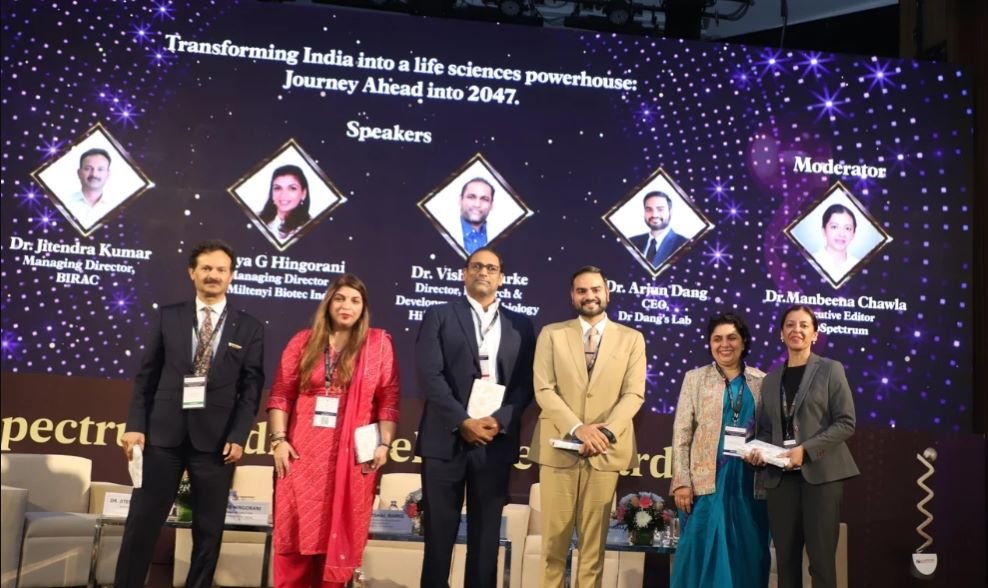
As India moves steadily towards the milestone of its centenary year of Independence in 2047, the life sciences sector is emerging as one of the most critical engines of national growth. From biotechnology and pharmaceuticals to diagnostics, medtech, and advanced therapies, the sector is expected to play a defining role in shaping India’s healthcare outcomes, economic resilience, and global competitiveness. Against this backdrop, a high-level panel discussion that took place during the BioSpectrum India Excellence Awards 2025 event, titled “Transforming India into a Life Sciences Powerhouse: Journey Ahead into 2047!” brought together key stakeholders to examine what it will take for India to realise this ambition.
Setting the tone for the discussion, Dr Jitendra Kumar, Managing Director, Biotechnology Industry Research Assistance Council (BIRAC) emphasised that India’s aspiration to become a global life sciences powerhouse must be rooted in deep science, long-term policy vision, and institutional capability building. While India has made significant progress over the past decade in nurturing biotech startups and innovation-led enterprises, he noted that the next phase of growth would require a shift from volume-driven expansion to science-led value creation.
Dr Kumar highlighted the transformative potential of artificial intelligence (AI) across the life sciences value chain, particularly in drug discovery, protein structure prediction, cell and gene therapy, genome editing technologies such as CRISPR, and precision medicine. However, he cautioned that AI adoption must go beyond surface-level applications and pilot projects.
According to him, India needs sustained investment in foundational AI research, especially within public research laboratories and academic institutions, to compete meaningfully on the global stage. He pointed out that while several AI-focused calls and initiatives have been launched, the depth of research required to build globally competitive platforms is still evolving.
Dr Kumar also underscored the importance of regulatory foresight and translational support, noting that innovation ecosystems cannot thrive on funding alone. Effective risk-sharing mechanisms, regulatory clarity, and stronger public–private collaboration are essential to ensure that promising ideas move seamlessly from laboratories to clinical and commercial deployment.
Advanced Therapies and the Manufacturing Imperative
Offering an industry perspective, Priya G Hingorani, Managing Director, Miltenyi Biotec India spoke about the rapid evolution of advanced therapies and the growing relevance of India in this space. She highlighted that cell and gene therapies, including CAR-T, represent a paradigm shift in modern medicine, with the potential to address diseases that were previously considered untreatable.
She explained that one of Miltenyi Biotec’s core strengths lies in its closed, end-to-end manufacturing platforms, which are designed to ensure consistency, quality, and scalability while minimising manual intervention. Such systems, she noted, are critical for maintaining global standards, particularly in highly complex biologics.
However, Priya acknowledged that India continues to face significant skill gaps in advanced therapy manufacturing and translational science. To address this, Miltenyi Biotec has initiated structured training programmes in partnership with institutional bodies and international collaborators, offering hands-on exposure to next-generation therapy platforms.
A central theme of her address was accessibility and affordability. Priya pointed out that globally, CAR-T therapies can cost close to half a million dollars, placing them beyond the reach of most patients. In contrast, India’s ecosystem is actively working towards making these therapies available at a fraction of global costs, without compromising on quality, safety, or regulatory compliance.
She also spoke about the concept of point-of-care manufacturing, where therapies are produced closer to patients, often within hospital settings. This approach not only reduces logistical challenges and turnaround times but is also particularly critical for patients with aggressive or life-threatening conditions, where delays can significantly impact outcomes.
AI, she added, is increasingly being integrated into manufacturing, clinical trials, and quality control processes, helping to compress development timelines and improve operational efficiency.
Nation Building Through Collaboration and Scale
Bringing a strong nation-building lens to the discussion, Dr Vishal Warke, Director – Research & Development (Microbiology), HiMedia Laboratories emphasised that India’s life sciences journey over the next two decades must be viewed as a mission rather than merely a commercial opportunity. He noted that while India has a rich talent pool and a strong tradition of scientific excellence, the ecosystem often struggles with fragmentation and scale-up challenges.
Dr Warke argued that the country does not lack ideas or innovation; rather, the bottleneck lies in translating these ideas into scalable, sustainable enterprises. He called for greater collaboration across the industry, urging established companies to play a more active role in mentoring and supporting startups.
Drawing parallels with global incubation models, he suggested that large Indian companies could provide startups with access to infrastructure, quality systems, regulatory guidance, and market insights, thereby improving survival rates and accelerating growth. Such collaboration, he noted, should be viewed as part of nation building, rather than a purely commercial exercise.
Affordability emerged as a recurring theme in his address. Dr Warke reiterated that innovation in India must ultimately benefit Indian patients. Even as companies expand into global markets and capture international value, maintaining world-class yet affordable products for domestic use is essential for building a sustainable and inclusive life sciences ecosystem.
Diagnostics, Precision Medicine, and AI in Practice
Representing the diagnostics sector, Dr Arjun Dang, CEO & Partner, Dr Dangs Lab spoke about the significant transformation underway in diagnostics, particularly in the wake of the COVID-19 pandemic. He noted that the crisis served as a catalyst, forcing laboratories and healthcare systems to adopt process-driven, technology-enabled models to ensure continuity under unprecedented constraints.
Dr Dang highlighted the growing shift towards precision diagnostics, where the emphasis is on delivering the right test to the right patient at the right time. He spoke about AI-driven platforms that curate personalised diagnostic packages based on individual health goals, lifestyle factors, and risk profiles, moving away from one-size-fits-all testing approaches.
He also shared insights into innovative, non-invasive tools being developed for early disease detection, including solutions for neurodegenerative disorders such as Alzheimer’s disease. Such technologies, he noted, have the potential to transform preventive healthcare and improve long-term outcomes.
At the same time, Dr Dang offered a note of caution on AI adoption, stressing that while AI can significantly enhance efficiency and decision-making, it must function as a support tool rather than a replacement for clinical judgment. He highlighted the risks of misinterpretation when complex medical data is presented directly to patients without adequate context.
Importantly, he spoke about AI’s role in addressing urban–rural healthcare disparities, particularly through remote reporting, digital pathology, and AI-assisted diagnostics that extend specialist expertise to tier II, tier III, and rural regions.
Skilling and Infrastructure: A Systemic Challenge
A recurring theme throughout the discussion was the urgent need for workforce skilling. The panellists agreed that advanced life sciences demand training at a level that traditional academic systems alone cannot provide. High-end research, manufacturing, and diagnostics require hands-on exposure to sophisticated equipment, regulated environments, and real-world workflows.
Industry participation was identified as a key solution to bridging this gap. The speakers emphasised that companies must open up their facilities and expertise to train the next generation of talent, supported by appropriate incentives and policy frameworks.
International models, particularly from Europe, where industry-integrated technical degrees are common, were cited as examples India could adapt. Such models blur the line between academia and industry, producing professionals who are both technically proficient and application-ready.
Strengthening India’s Global Positioning
An important dimension that emerged during the discussion was India’s growing visibility on the global life sciences map. As multinational companies increasingly look to diversify supply chains and innovation hubs, panellists noted that India is well positioned to evolve beyond being a cost-efficient destination to becoming a source of high-quality science, innovation, and leadership.
Strategic international collaborations, participation in global clinical trials, and harmonisation of regulatory standards were identified as critical enablers for this transition. At the same time, speakers stressed that global competitiveness must go hand in hand with domestic capacity strengthening, including resilient supply chains, indigenous technology platforms, and reduced dependence on imports for critical inputs.
The Road Ahead to 2047
Summing up the discussion, Dr Manbeena Chawla, Executive Editor, BioSpectrum India & Asia noted that India’s ambition to become a life sciences powerhouse by 2047 is achievable. However, success will depend on the ecosystem’s ability to adopt a mission-driven, collaborative approach, supported by consistent policy, sustained investment in deep science, and responsible use of emerging technologies.
The panel discussion underscored that India’s life sciences future will not be defined by isolated successes or individual champions, but by the strength of its collective ecosystem—where government, industry, academia, and healthcare providers work in concert to translate innovation into impact at scale.
As India looks towards 2047, the discussion reinforced a clear message: the foundation is in place, the talent exists, and the opportunity is immense. What is now required is alignment, execution, and an unwavering commitment to ensuring that innovation serves both national priorities and global aspirations.
Image caption- L-R- Dr Jitendra Kumar, Managing Director, Biotechnology Industry Research Assistance Council (BIRAC); Priya G Hingorani, Managing Director, Miltenyi Biotec India; Dr Vishal Warke, Director – Research & Development (Microbiology), HiMedia Laboratories; Dr Arjun Dang, CEO & Partner, Dr Dangs Lab; Manasee Kurlekar, CEO, BioSpectrum and Trustee, MMA Spectrum Foundation (felicitating the panelists and the moderator); Dr Manbeena Chawla, Executive Editor, BioSpectrum.